She Said He Looked Possessed: Processing a Call Where You Never Saw What She Described
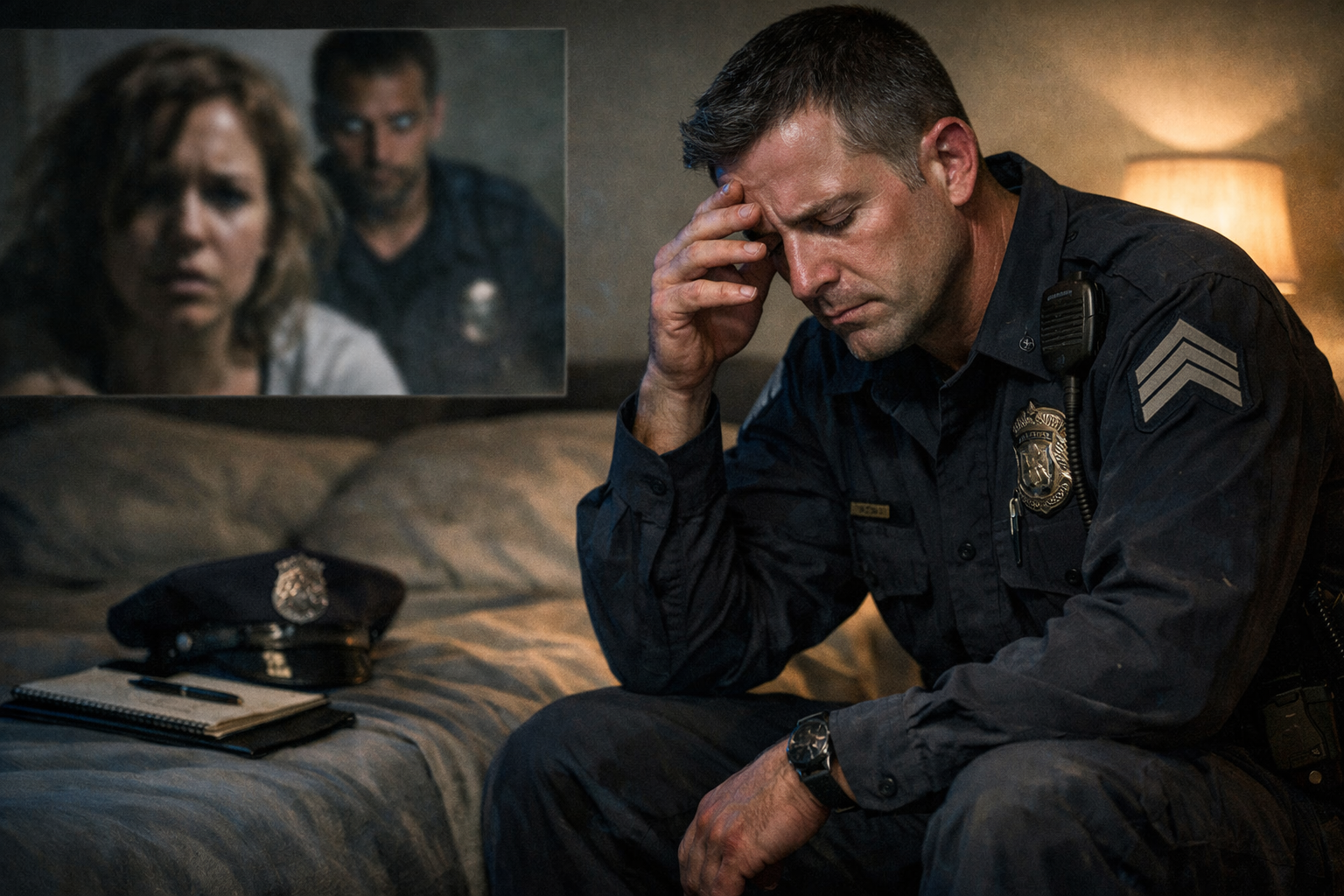
You're home now. Or almost home. The call is closed, the report is filed or nearly filed, and he was fine when you got there — cooperative, calm, maybe even friendly. Nothing to see. Nothing that matched what she was trying to tell you.
And she was trying to tell you something.
That's the part that's sitting with you. Not what you saw — you didn't see much. It's what she said. The way she said it. The way she reached for words and couldn't quite find them and kept circling back to something she clearly needed you to understand and you weren't sure you did.
She said something like he looked possessed. Or that he was lying there but not sleeping, scanning the room with his whole body. Or that he was shaking but not scared. Or that it felt like being in a room with an animal.
And he was standing right there being perfectly normal.
You took the report. You were professional. You did what you could with what you had. But somewhere on the drive home a quiet question opened up and it hasn't closed yet.
What was she actually describing?
This article is the answer to that question.
Why He Was Fine When You Got There
Start here, because this is the part that makes the whole call hard to hold onto.
The predatory vigilance state she was describing is not a permanent condition. It is a nervous system state — a mode of physiological activation that is triggered by specific internal and environmental conditions and that resolves when those conditions change. When you arrived, the conditions changed. The presence of law enforcement altered the threat environment he was processing, and his nervous system shifted out of the monitoring state and back into the social, managed presentation that people default to when authority is present.
This is not performance in the theatrical sense — it is not necessarily conscious or deliberate. It is the nervous system responding to a changed environment the same way it responded to whatever triggered the state in the first place. The threat landscape shifted. The state resolved.
She has watched this happen before. Probably many times. He goes somewhere terrifying and then, when something changes — a phone call, a knock at the door, her leaving the room — he comes back. And he seems fine. And she is left holding the memory of something she cannot prove and he may not even fully remember.
This is exactly why she struggled to describe it to you. Not because it didn't happen. Because it never leaves evidence. Because by the time anyone else arrives, it's already over.
What She Was Actually Describing
She was not being dramatic. She was not exaggerating. She was not unstable or confused or reaching for effect. She was using the only language available to her to describe a specific, documented, physiologically real behavioral state that she has lived inside of and that her culture has never given her words for.
Here is what that state looks like from the outside — which is where she was watching it from.
The lying there that isn't resting
When she told you he was lying down but she knew he wasn't asleep — she was describing a real perceptual read of a real physiological difference. Genuine rest involves a nervous system that has downregulated. Muscle tone decreases. Breathing slows. The face softens. The body becomes heavy.
What she was observing was the opposite in a horizontal body. He was still, but the stillness was active — controlled, oriented, maximally alert. The nervous system was not downregulating. It was running at high activation while the body held position. Like a predator in stillness before a strike — conserving energy while maintaining full environmental awareness.
She felt the difference. She has probably always felt the difference. She just never had language for why those two kinds of lying down feel completely unlike each other.
The scanning that used his whole body
When she described him coming up and turning his whole body to look around the room — not just his head, his whole torso rotating like a single unit — she was describing a specific motor pattern that emerges in extreme autonomic arousal states.
Normal social movement is partial and economical. We turn our heads. We glance. The body doesn't need to be involved because we are operating in a social environment where full-body threat orientation is unnecessary.
In a high-activation predatory state, the body organizes itself as a single orienting unit. Everything rotates together to bring the full sensory system to bear on the environment. It is rapid, mechanical, and total. It looks robotic or animal because it bypasses the casual, socially modulated quality of normal human movement entirely.
She described it accurately. She just didn't have a name for what she was seeing.
The eyes
When she mentioned his eyes — too wide, not blinking, oriented at the room rather than at her — she was describing the direct physiological output of maximum sympathetic nervous system activation. Pupil dilation. Blink suppression. Wide-field environmental scanning rather than social gaze.
These are involuntary. They are not expressions of emotion. They are the visual system reconfiguring itself for threat detection rather than social interaction. The eyes stop performing social functions and start performing tactical ones.
She read that shift correctly. It registered in her as wrongness before she could name why. That registration was accurate.
The animal comparison
When she said it felt like being in a room with an animal — or that something came over him, or that it wasn't him anymore — she was not reaching for dramatic effect. She was making a neurologically precise observation with imprecise language.
The predatory vigilance state involves significant downregulation of the prefrontal cortex — the part of the brain responsible for social cognition, emotional processing, and conscious self-awareness. What remains dominant is the older, deeper threat-response architecture. The parts of the brain that predate social humanity. The parts we share with animals.
She felt the absence of the social human. That is what she was trying to tell you. Not that he became literally an animal — that the social, relational, emotionally present person she knows ceased to be the operating system in that moment. Something older and more dangerous was running instead.
Her nervous system detected that absence and correctly classified it as a categorical threat.
What She Was Giving You
Here is the thing about her account that matters most for how you feel about the call right now.
She was not just describing her experience. She was giving you threat intelligence about a specific man's escalation pattern — intelligence gathered over months or years of living inside a threat environment and developing an exquisitely calibrated read of his specific behavioral cycle.
She knows what this state predicts in him. She has watched it before. She knows what comes after it, or what has come after it in the past. She came forward and told you about it because her nervous system assessed the current risk as high enough to warrant that.
That is not nothing. That is a field report from the most qualified observer of this specific man's threat behavior available to you.
The question of whether you did enough with it is worth sitting with — not to punish yourself, but to learn from it.
The Honest Questions to Sit With Tonight
Not to spiral. Not to catastrophize. Just to close the loop honestly so you can file this call correctly in your own mind and do better with the next one.
Did you document her description in her words?
Not a summary. Not "victim reported subject acting strange." Her actual words — the animal comparison, the full-body scanning, the lying there that wasn't sleeping, whatever specific language she used. That language is behavioral threat data. It belongs in the record verbatim. If it isn't there, and the report is still open, add it.
Did you ask her what usually comes after?
She has longitudinal data on this man's escalation cycle that you don't have. The most important question on a call like this is: has this happened before, and what came after? If you asked it, good. If you didn't, file that question away for next time. Her answer to that question is the most predictive data point available to you on scene.
Did you do a lethality assessment?
The behavioral pattern she described — predatory vigilance state, established escalation cycle she has learned to fear — is a high-lethality indicator regardless of whether physical violence occurred in the most recent incident. If your department has a lethality assessment protocol, this call warranted it. If it didn't happen, that is useful information about a gap in your current practice. Not a reason for guilt — a reason to close the gap.
Did you connect her to anything before you left?
Information about local advocacy resources, her legal options, what she can do if it happens again. If you did, good. If the call moved fast and she was minimizing by the end and you left without making that connection — note it. That handoff is one of the highest-value things you can do on a call like this.
What to Do With the Unsettled Feeling
The feeling that's still running in you is not anxiety about your performance. It is the residue of a call where something real was communicated to you about a real and ongoing danger — and then you walked away from it without a clean resolution, because clean resolutions are not available on calls like this.
He was fine. She was scared. The gap between those two realities is where intimate partner homicide lives.
You felt that gap on this call. That feeling is appropriate. It means your threat detection is calibrated correctly.
What to do with it:
Read. The pieces on this site about predatory vigilance behavior, pre-attack indicators, and the language gap in domestic violence were written so that when you encounter something like this, you have a framework waiting. You have it now. Use it on the next call.
Talk to someone who gets it. Not to debrief the whole call — just to say out loud: she described something I didn't have a name for, and now I do. Saying it out loud to someone who understands closes the loop that reading alone can't fully close.
Don't override the instinct that kept this call alive in you on the drive home. That instinct is an asset. It is telling you this call mattered. It did. File it as such — in your report, in your memory, and in how you approach the next one.
What You're Taking Into the Next Call
You are leaving this call knowing something you didn't know when you arrived at it.
You know what a predatory vigilance state is. You know what she was describing when she said he looked possessed. You know that the animal comparisons are not hysteria — they are accurate threat detection in imprecise language. You know that his calm presentation when you arrived was not evidence that her account was wrong. You know what questions to ask on the next call like this, and what to do with the answers.
That is not a small thing to take out of a call where you saw nothing.
She tried to tell you something tonight. You listened well enough that it's still with you hours later. That matters more than you might think.
ThreatReady LE publishes weekly intelligence on threat recognition and trauma-informed practice for law enforcement. Subscribe free at threatreadyle.com.
Frequently Asked Questions
He seemed completely fine when I got there. Does that mean she was exaggerating or misreading the situation?
No — and this is probably the most important thing to understand about calls like this one. The predatory vigilance state is not a permanent condition. It is a nervous system state that resolves when the environment changes. Your arrival changed the environment. His nervous system shifted out of the monitoring state and back into managed, social presentation — not necessarily consciously or deliberately, but because the threat landscape he was processing had altered. His calm presentation to you is entirely consistent with everything she described. She has almost certainly watched him make exactly this shift before — go somewhere terrifying and then snap back to normal when something changes. It may be part of why she has hesitated to report before. She knows how it looks. She came forward anyway.
I didn't really know what she was describing on scene. Does that mean I handled it wrong?
Not necessarily — but it is worth being honest with yourself about what you did with what she gave you. The behavioral state she was describing is not covered in most law enforcement training curricula. You were not equipped with a framework for it before this call. That is a training gap, not a personal failing. What matters now is what you do with the call going forward — whether the documentation captures her description accurately, whether a lethality assessment was completed, whether she was connected to advocacy resources before you left. If any of those things didn't happen, some of them may still be recoverable. If the report is still open, her verbatim language belongs in it.
She used really strange language — possessed, like an animal, not human. Should I have taken that more seriously?
Yes — and now you know why. Animal comparisons and possession language in victim descriptions of abuser behavior are not throwaway metaphors and they are not signs of instability. They are the most accurate language available to someone describing a state that their culture has never given them clinical vocabulary for. Research on high-lethality domestic violence consistently surfaces this kind of language from survivors. When a victim reaches for those comparisons, she is telling you that his behavior crossed outside the range of normal human social conduct in a way her nervous system registered as a categorical threat. That registration is data. It belongs in the report and it belongs in the lethality assessment.
What should I have asked her that I maybe didn't?
The single most valuable question on a call like this — and the one most often skipped — is: has this happened before, and what came after? She has longitudinal data on this specific man's escalation pattern that you don't have access to any other way. Her answer to that question is the most predictive information available to you on scene. Beyond that: what were his eyes doing, what did his body do, did he say anything or was he silent, how long did it last, what made it stop. Behavioral, descriptive questions rather than interpretive ones. Not did he seem angry — what did you see his body doing. The more specific her account, the more useful your documentation.
What if my report is already filed and I didn't capture her description well?
Depending on your department's supplemental report policy, it may not be too late. If you can add a supplemental, do it. Write what she said as close to her exact words as possible — the specific behavioral descriptions, the language she used, the sequence she described. Note that she provided this account during your on-scene contact. Precise, behavioral, verbatim documentation is what builds a record that protects her if something happens later. A report that says victim reported subject acting strange protects no one. A report that captures her specific language about the scanning, the eyes, the full-body movements, the animal quality — that is a document with signal in it.
Should I have done a lethality assessment even though nothing physical happened?
Yes — and the threshold for initiating one should be lower than many officers apply in practice. A formal lethality assessment does not require a physical assault to have occurred. The behavioral pattern she described represents meaningful threat intelligence that warrants formal screening regardless of whether he made physical contact in the most recent incident. Most validated lethality tools include questions about escalation patterns, about fear, and critically about the victim's own assessment of whether he could kill her. That last question is the most predictive single item on most instruments. If it wasn't asked on this call, ask it on the next one. And if your department doesn't have a lethality assessment protocol, that is a gap worth raising with your supervisor.
She started minimizing toward the end of the call. Does that mean her original account wasn't accurate?
No. Minimization following a detailed account is one of the most predictable features of domestic violence victim interviews. She may have minimized because she sensed consequences arriving and got scared, because she was managing his reaction if he was nearby, because your visible uncertainty made her second-guess herself, or because she has practiced making it smaller in order to survive living with it. The original account — the one she gave before social pressure shaped it — has the highest signal value. The minimization that followed it is also data, specifically about the environment she is navigating. Both belong in your documentation. Neither cancels the other out.
I keep replaying the call. Is that normal?
Yes — and it means something specific. You are replaying it because something real was communicated to you about a real and ongoing danger, and you left the scene without a clean resolution. The brain replays unresolved threat material. It is not a sign that something is wrong with you. It is a sign that your threat detection is calibrated correctly and that this call registered as something worth understanding. The replay tends to slow down once the experience has been named, processed, and filed into a framework. You have that framework now. Give it a little time.
What do I do if something happens to her after this call?
First — understand that if something happens, it is not because you failed her singlehandedly. Domestic violence lethality is the product of a system-wide failure that starts long before any individual call and involves legal thresholds, institutional gaps, and cultural blind spots that no single officer can close. What you are responsible for is the quality of your documentation, the referrals you made, and the professionalism of your contact with her. If you did those things to the best of your ability with the knowledge and tools you had, that is what you are accountable for. If there were gaps — document what you learned from this call and close them on the next one. Guilt that produces better practice is useful. Guilt that just loops is not.
How do I get better at recognizing this kind of call in the future?
Read the behavioral science. The pieces on this site about predatory vigilance states, pre-attack indicators, and the language gap in domestic violence are written specifically for this purpose — so that the next time a woman is standing in front of you reaching for words for something she has never had language for, you have a framework to receive what she is giving you. Beyond reading: ask behavioral questions on every DV call, not just the ones that seem serious. Document verbatim language always. Do lethality assessments consistently, not selectively. And when a victim says something that sounds strange or extreme — possessed, like an animal, not human — treat it as the most important thing she said, because it usually is.