Why "Gut Instinct" Is Actually Pattern Recognition — And How to Train It
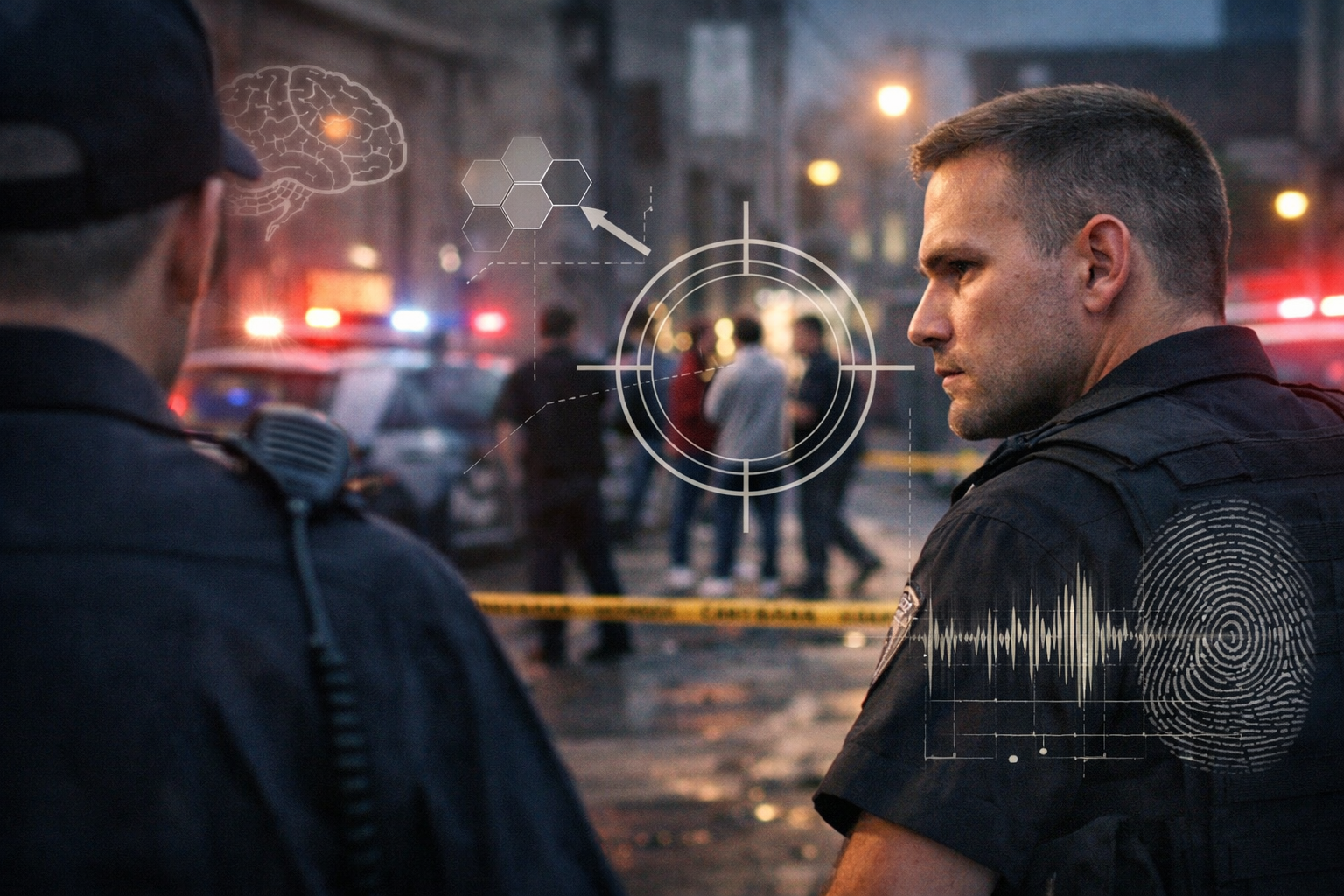
You've had the feeling. You roll up on a call or walk into a location and something registers before you've consciously processed anything. Not a thought. Not a checklist item. A feeling — low in the chest or somewhere behind the sternum — that says something is wrong here.
Sometimes you act on it and you're right. Sometimes you act on it and nothing materializes. And sometimes — the times that stay with you — you didn't act on it, and you should have.
The conversation in law enforcement about gut instinct tends to go one of two directions. Either it gets mystified — treated as a sixth sense, an innate gift some officers have and others don't, something you either have or you don't. Or it gets dismissed — treated as bias dressed up in respectable clothing, a post-hoc rationalization for decisions already made on other grounds.
Both of those framings are wrong. And both of them are dangerous.
What the neuroscience actually shows is more useful than either: gut instinct is pattern recognition. It is a real cognitive process with a documented neural architecture, a trainable skill set, and specific failure modes that can be identified and corrected. Understanding what it actually is changes how you develop it, how you trust it, and how you audit it.
This article is about all three.
What the Gut Is Actually Doing
The feeling you experience as instinct is the output of a process that begins in the brain's perceptual systems and moves faster than conscious thought.
Your brain is a prediction machine. Its primary function — more fundamental than reasoning, more fundamental than language — is to build and continuously update a model of the environment that allows it to predict what will happen next. It does this by extracting patterns from experience and storing them as implicit memory: not the kind of memory you can consciously recall and narrate, but the kind that operates below awareness and shapes perception automatically.
When you walk into a scene, your brain is not processing it neutrally. It is instantly comparing everything it perceives — the spatial arrangement, the body language of the people present, the sounds, the smells, the micro-expressions, the movement quality — against its stored library of patterns. Most of the time, the comparison produces a match: this scene is consistent with the patterns associated with normal, safe, predictable environments. That match produces nothing you consciously register. The absence of alarm is itself the output.
When something in the scene fails to match — when a detail or a cluster of details falls outside the range of patterns the brain associates with safe, predictable environments — the mismatch triggers the amygdala. The amygdala does not send a detailed report to the prefrontal cortex explaining which specific pattern was violated and why. It sends a signal. An alarm without a label. A feeling.
That feeling is what you experience as gut instinct.
It is not magic. It is your brain's pattern-matching system flagging a mismatch between what it is perceiving and what its stored library predicts. The gut feeling is the alarm. The pattern library is where the intelligence actually lives.
The Neural Architecture Behind the Feeling
Understanding the specific neural systems involved is useful because it explains both the power and the limits of instinct — and it points directly to how training works.
The amygdala: the alarm system
The amygdala is a small, almond-shaped structure deep in the brain's temporal lobe, and it is the primary threat detection and alarm system in the human nervous system. It processes incoming sensory information extremely rapidly — faster than the conscious, deliberate processing of the prefrontal cortex — and it has direct access to the stress response systems that produce the physiological sensations you experience as the gut feeling.
Critically, the amygdala can trigger a threat response before the prefrontal cortex has finished processing the scene. This is the neural basis of the feeling that something is wrong before you know why. The amygdala flagged a pattern mismatch and fired. The prefrontal cortex is still catching up.
The basal ganglia: the pattern library
The basal ganglia are a group of structures involved in habit formation, procedural learning, and the storage of implicit patterns. When you develop expertise in any domain — chess, surgery, law enforcement — the patterns associated with that expertise get progressively encoded in the basal ganglia as automatic, fast, effortless pattern recognition.
This is why experienced officers read scenes faster than rookies. It is not that their conscious reasoning is faster. It is that their basal ganglia have a richer, more calibrated pattern library to compare incoming information against. The mismatch detection happens faster and with greater specificity because the library is larger and better organized.
The insula: the body as signal
The insula is a cortical region involved in interoception — the perception of the body's internal states. It is the neural structure most directly associated with the felt sense of the gut feeling: the tightening in the chest, the drop in the stomach, the prickling at the back of the neck.
The insula is where the body's physiological response to the amygdala's alarm signal becomes conscious experience. It is why the gut feeling is felt in the body rather than thought in the mind. The body is not a metaphor in this context. It is a literal signal transmission system.
What Goes Into the Pattern Library
The quality of your instinct is directly determined by the quality of your pattern library. This is the central insight for training — and it is also where the bias problem enters.
Experience builds the library — but not all experience builds it equally
Raw experience accumulates patterns, but not all patterns are equally accurate or equally useful. If your experience is limited to a narrow range of environments, populations, and situations, your pattern library will be calibrated to that narrow range — and it will generate false alarms in situations that fall outside it simply because they are unfamiliar, not because they are dangerous.
This is the mechanism by which implicit bias enters gut instinct. Not through malice. Through a pattern library that has been built on skewed inputs.
An officer whose early career was spent primarily in high-crime neighborhoods with predominantly minority populations will develop a pattern library in which certain demographic markers are associated — implicitly, automatically, below conscious awareness — with threat cues. Not because those demographic markers are actually threat cues, but because the library was built in an environment where they co-occurred with genuine threat cues. The library cannot distinguish between correlation and causation. It just stores patterns.
When that officer gets a gut feeling about a person on the street, the feeling is real. The neural process producing it is real. But the pattern it is responding to may be demographic rather than behavioral — and that is not threat detection. That is bias wearing the clothes of instinct.
Behavioral patterns are the signal. Everything else is noise.
The critical discipline in building a high-quality pattern library is learning to distinguish behavioral patterns from demographic patterns. Behavioral patterns — body language, movement quality, gaze behavior, proxemic signals, physiological arousal indicators — are genuine threat signals. They are generated by the nervous system states of the people you are observing and they carry real information about intent, arousal level, and potential action.
Demographic patterns — race, age, gender, clothing style, neighborhood — are not threat signals. They are context variables that the pattern library will absorb if you let it, because the brain does not automatically filter its inputs for validity. It stores what it sees. If what it sees is systematically skewed, the library will be systematically skewed.
Training your instinct means deliberately enriching the behavioral signal in your pattern library while auditing and correcting for the demographic noise that has inevitably accumulated in it.
How Bias Creeps In — And How to Catch It
Bias in pattern recognition is not a character flaw. It is a cognitive architecture problem. The same system that makes you good at reading threat signals is the system that absorbs skewed patterns from skewed inputs. You cannot opt out of the architecture. You can only learn to audit it.
The post-hoc rationalization problem
One of the most important findings in the cognitive science of decision-making is that people are extremely good at generating conscious explanations for decisions that were actually made by unconscious processes. When the amygdala fires and produces a gut feeling, the prefrontal cortex typically constructs a narrative explanation for why the feeling makes sense — and that narrative feels like the reason for the feeling, even when it isn't.
This means that asking yourself why you have a gut feeling about someone is not sufficient to detect bias. The prefrontal cortex will produce a plausible-sounding behavioral explanation even if the actual trigger was demographic. The narrative and the real cause can be completely disconnected.
Auditing for behavioral specificity
A more reliable method is to audit for behavioral specificity. When you have a gut feeling, ask yourself: what specific behavior am I observing that is producing this feeling? Not a general impression — a specific, observable, describable behavior.
If you can identify a specific behavioral signal — a particular movement pattern, a specific gaze behavior, a physiological arousal indicator, a proxemic violation — the feeling has behavioral grounding. If the most specific answer you can produce is a demographic description or a general impression of wrongness without behavioral content, that is a flag that the feeling may be driven by demographic pattern rather than behavioral signal.
This is not about second-guessing every instinct. It is about building the habit of behavioral specificity that simultaneously sharpens genuine threat detection and catches bias before it produces action.
Seek disconfirming experience deliberately
The pattern library is built from experience. If your experience is narrow, the library is narrow. The most direct way to correct for a skewed library is to deliberately expose yourself to a wider range of inputs — to accumulate experience with the full demographic range of both threatening and non-threatening people, so that the library can recalibrate the actual base rates.
This means actively noticing when your gut feeling fires and nothing materializes — and treating that as data about your false positive rate rather than as a near-miss. It means seeking out training scenarios and contacts that introduce demographic variability into your pattern inputs. And it means being honest with yourself about the environments and populations your library was built on, and where its calibration is likely to be off.
How to Deliberately Train Pattern Recognition
The pattern library is not fixed. It is continuously updated by experience — which means it can be deliberately shaped by the right kind of experience and the right kind of reflection on that experience.
Deliberate observation practice
The most direct training input for pattern recognition is deliberate, attentive observation with feedback. This means not just being present on calls but actively noticing and naming specific behavioral signals — what you are seeing, in behavioral terms, before you know how the scene resolves.
Make it a habit to narrate behavioral observations to yourself on scene, even silently. His blink rate is suppressed. Her gaze is tracking the exits. His weight is on his back foot. Her breathing is elevated. Naming what you observe in behavioral terms rather than impressionistic terms does two things simultaneously: it enriches the behavioral signal in your pattern library, and it builds the habit of behavioral specificity that audits for bias.
Over time, this deliberate naming process becomes automatic. The explicit narration becomes implicit pattern recognition. The skill internalizes.
Study baseline behavior obsessively
Pattern recognition is mismatch detection. Mismatch detection requires a calibrated baseline. The richer and more accurate your model of normal human behavior — what normal eyes look like, what normal movement quality looks like, what normal proxemic behavior looks like across a full range of contexts and populations — the more sensitive and specific your mismatch detection becomes.
Study baseline behavior the way a cardiologist studies normal heart rhythms. Know what normal blink rates look like. Know what normal gaze behavior looks like in conversation versus in stress. Know what normal body language looks like when someone is waiting versus when someone is watching. Know what normal breathing looks like versus the elevated, visible respiration of high autonomic arousal.
When you know normal with precision, abnormal announces itself.
After-action reflection, not just after-action review
Formal after-action review focuses on what happened and what the outcome was. After-action reflection — which is a personal, internal practice rather than an institutional one — focuses on what you perceived and when you perceived it relative to what actually unfolded.
When a call resolves, ask yourself: when did I first get the feeling? What specific signals was I picking up at that point? How did the scene develop relative to what my instinct was flagging? Where was I right? Where did I generate a false positive, and what was I actually responding to?
This reflection practice is how the pattern library gets calibrated rather than just accumulated. Without reflection, experience builds a library. With reflection, experience builds an accurate library.
Learn from officers whose instinct you respect
Pattern recognition expertise is partly transferable through language. When you encounter an officer whose threat detection you respect, ask them to narrate what they are seeing — not what they feel, but what they are specifically observing. The behavioral vocabulary they use to describe their observations is a direct transmission of pattern library content. You are not going to absorb their full library through conversation, but you will accelerate the development of your own.
This is also how you audit each other's instinct for bias. An officer who can describe their gut feelings only in demographic terms and an officer who can describe them in rich behavioral terms are showing you something important about the calibration of their respective libraries.
The Officer Who Trusts Their Instinct Well
The goal is not to trust your instinct blindly. It is not to distrust it reflexively. It is to develop a calibrated relationship with it — one in which you understand what it is, what it is responding to, where it is likely to be accurate, and where it is likely to be off.
A well-calibrated officer trusts the feeling enough to act on it — to reposition, to ask the question, to stay on scene a little longer, to take the report more seriously. And they have enough insight into their own pattern library to know when the feeling needs to be interrogated before it drives action — when it might be demographic noise rather than behavioral signal.
That calibration is not a compromise between effectiveness and ethics. It is what effectiveness actually looks like when you understand the system you are working with.
The gut feeling is real. The pattern recognition behind it is real. The library it draws on is trainable, auditable, and correctable.
That is better news than either mystifying it or dismissing it. It means the skill is yours to develop — deliberately, accurately, and with your eyes open.
ThreatReady LE publishes weekly intelligence on threat recognition and trauma-informed practice for law enforcement. Subscribe free at threatreadyle.com.
Frequently Asked Questions
Is gut instinct actually reliable, or is it just bias with better PR?
Both things are true simultaneously, and holding that tension is the beginning of using it well. Gut instinct is a real cognitive process with a documented neural basis — it is the output of a pattern-matching system that has been built from genuine experience and that can detect real threat signals faster than conscious reasoning. It is also a system that absorbs skewed inputs without filtering them for validity, which means bias can enter the library and produce feelings that are real in their neurological mechanism but unreliable in their signal content. The answer is not to trust it completely or dismiss it entirely. The answer is to develop enough insight into your own pattern library to know when the feeling is likely to be behaviorally grounded and when it needs to be interrogated before it drives action.
How do I know if my gut feeling is based on behavior or on bias?
Ask yourself one question: what specific behavior am I observing? Not a general impression. Not a demographic description. A specific, observable, describable behavior — a movement pattern, a gaze behavior, a physiological arousal indicator, a proxemic signal. If you can identify a concrete behavioral answer, the feeling has grounding. If the most specific answer you can produce is a demographic characteristic or a vague sense of wrongness without behavioral content, that is a flag worth taking seriously. This is not about second-guessing every instinct on scene — it is about building a habit of behavioral specificity that simultaneously sharpens genuine threat detection and catches bias before it produces action.
Can pattern recognition actually be trained, or is it something you either have or you don't?
It can absolutely be trained — and the research on expertise development across domains from chess to surgery to military threat assessment is unambiguous on this point. The pattern library is not fixed at birth or at the academy. It is continuously updated by experience, and the right kind of experience with the right kind of reflection on that experience builds a more accurate, more calibrated library over time. What separates officers with sharp instinct from those without it is not innate talent — it is the accumulated quality of their pattern inputs and the degree to which they have reflected on those inputs rather than just absorbed them. That process can be deliberate rather than accidental.
Why does gut instinct sometimes feel stronger about certain demographics even when I'm trying to be fair?
Because the pattern library does not respond to intentions — it responds to inputs. If your formative experience as an officer was concentrated in environments where certain demographic markers co-occurred with genuine threat cues, your library will have encoded that co-occurrence as a pattern regardless of your conscious values or commitments. The feeling that results is real. The neural process producing it is real. But the pattern it is responding to is correlational rather than causal — the demographic marker was present alongside the threat cue, so the library stored them together. Correcting for this requires deliberately widening the range of inputs your library is built on, accumulating experience with the full demographic range of both threatening and non-threatening people so the library can recalibrate its actual base rates.
What's the difference between a gut feeling and fear?
They can overlap but they are not the same thing. Fear is a response to a perceived threat to yourself — it has a self-protective, survival-oriented quality and it tends to produce withdrawal or defensive behavioral preparation. A gut feeling about threat in the environment is more outwardly oriented — it is a mismatch signal about what you are observing rather than a direct threat to your own safety. In practice, the two can blur together on scene, particularly in high-stakes situations. The skill of distinguishing them matters because fear can narrow perception and produce tunnel vision, while well-calibrated threat detection should be expanding your perceptual field. If what you are experiencing is narrowing your attention rather than broadening it, that is closer to fear than to threat detection, and it needs to be managed differently.
How long does it take to build a reliable pattern library?
The research on expertise development suggests that deep pattern recognition in complex domains typically requires thousands of hours of deliberate, reflective practice — not just passive experience. Raw time on the job builds a library, but it builds whatever library the experience happens to provide, accurate or not. Deliberate observation practice, after-action reflection, and active study of behavioral baselines accelerate the calibration process significantly. There is no precise timeline because the quality of the inputs matters more than the quantity of hours. An officer who spends five years doing deliberate, reflective behavioral observation will have a more accurate library than an officer who spends fifteen years accumulating experience without reflection.
Should I always act on a gut feeling or wait until I can articulate why?
Neither as an absolute rule. The right approach depends on the stakes and the time available. In a rapidly evolving scene where delay carries physical risk, acting on the feeling while staying alert to disconfirming information is appropriate — you do not need to be able to articulate the pattern to respond to it. In slower-moving situations where you have time to interrogate the feeling before acting — a contact, an interview, a report decision — the habit of asking what specific behavior is producing it is worth building. The goal is not to require conscious articulation before every action. It is to develop enough calibration that you know which of your gut feelings to trust immediately and which ones to hold up to the light first.
Can trauma affect an officer's pattern recognition over time?
Yes — significantly and in specific ways. Cumulative trauma exposure can produce a pattern library that is calibrated toward threat in environments that don't warrant it — a persistent low-level alarm state that generates false positives not because the inputs were demographically skewed but because the nervous system has been conditioned by repeated genuine threat exposure to read ambiguous signals as dangerous. This is sometimes called hypervigilance, and it is a meaningful occupational hazard in law enforcement. It produces real feelings that feel exactly like threat detection but that are driven by nervous system sensitization rather than environmental signal. Officers who notice that their gut is firing constantly, in low-stakes environments, at a rate that doesn't match outcomes, should consider whether cumulative trauma exposure is recalibrating their baseline — and seek support accordingly.
How does this apply to reading victims and witnesses, not just suspects?
The same pattern recognition system that reads threat in subjects also reads credibility, distress, and concealment in everyone you interact with. The baseline behavior principles apply equally — knowing what genuine distress looks like, what managed presentation looks like, what dissociation looks like, what the behavioral markers of fear are versus the behavioral markers of deception. The bias audit applies equally too — the pattern library can encode skewed credibility judgments just as readily as skewed threat judgments. An officer whose library was built in environments where certain demographic groups were more often on one side of a call than another may have implicit credibility calibrations that do not reflect actual credibility. The discipline of behavioral specificity — what specific behavior am I observing — is the same corrective in both directions.
What's the single most useful thing I can do starting today to sharpen my pattern recognition?
Name what you observe, in behavioral terms, before you know how the scene resolves. Not impressions. Not demographic descriptions. Specific behavioral observations — what the eyes are doing, what the body is doing, what the proxemic behavior is, what the physiological arousal indicators are. Do this on every call, every contact, every interaction. At the end of the shift, pick one call and spend five minutes asking yourself what you perceived and when, relative to how things unfolded. That combination — deliberate behavioral narration on scene, followed by brief reflective review after — is the most direct available input into both pattern library calibration and bias detection. It costs almost nothing. Over time, it compounds into something significant.