The Case That Stayed With You: If You Reached Out, You're Not Alone
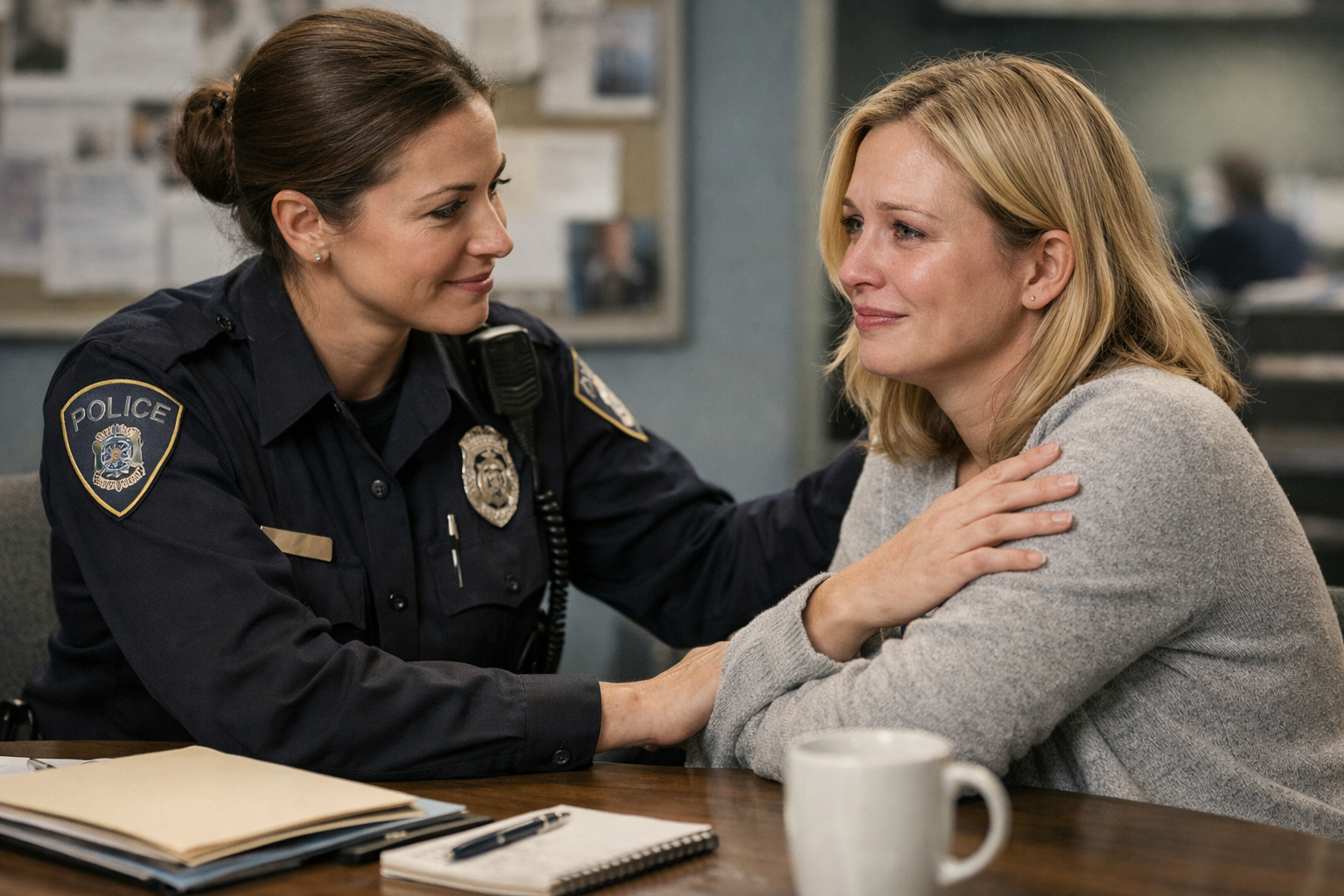
This article is going to say something that doesn't get said in any official training, any department policy, any wellness program with an institutional logo on it.
Some officers reach out to victims from prior cases.
Not many. Not openly. Not in ways that show up in any data set or get discussed in any formal context short of a retirement speech or a conversation that happens in a parking lot after a shift with someone you trust completely. But it happens — across departments, across jurisdictions, across career lengths — and the officers who have done it carry it quietly, sometimes for years, because there is no sanctioned space to acknowledge it and no framework for processing what drove them to it.
If you are reading this because you did it, or because you are thinking about doing it, or because you have been thinking about it for longer than you want to admit — this is that space.
It Happens. Here's Why.
The job puts officers inside the worst moments of other people's lives and then structurally requires them to leave.
You are present for something — a DV call, a welfare check, a disclosure that took years to make and happened in a ten-minute window on your shift — and then the call closes and you move on. Except part of you doesn't move on. The case lodges somewhere. The face stays. The thing she said stays. The look when you left — the one that said please don't go or I knew you wouldn't believe me or just a quiet, exhausted resignation that has never fully left your memory — that stays too.
Weeks later, or months later, or sometimes years later, the thought surfaces: I wonder if she's okay. And then, for some officers, the thought becomes something else. A search. A number. A message that gets drafted and deleted and drafted again. And for some of those officers, eventually, it gets sent.
The research on secondary traumatic stress in law enforcement points directly at this mechanism. Officers are not traumatized only by violence. They are traumatized by the permanent open loops — the cases that never resolved in any way they could see, the human contacts that were truncated by the structure of the work before they could mean anything, the accumulated weight of being present at crisis after crisis with no legitimate pathway to know what happened after you left.
The impulse to reach out is the psyche's attempt to close one of those loops. It is not predatory. It is not inappropriate in its origin. It is a human being trying to reconnect with another human being whose worst moment they were present for, and trying to say — in whatever words they could find — that it mattered, that they were believed, that someone still thinks about them.
That is not a character flaw. That is what happens when a caring person does this work long enough without anywhere legitimate to put what it deposits.
If You Did It: Don't Panic
If you reached out to someone from a prior case — a text, a call, a message, a note — and you are now sitting with the weight of that, the first thing to say is: don't panic.
Not because it wasn't a serious thing to do. It was. The risks are real and they will be addressed honestly in this article. But panic produces bad decisions, and the decisions available to you right now are important ones that need to be made clearly.
You are not the first officer this has happened with. You will not be the last. The fact that it happened means something about what you are carrying — not about who you are as an officer or as a person.
Here is what to do.
Stop
Do not reach out again. Whatever the response was — positive, negative, no response at all — additional contact compounds every risk that existed with the first contact. One instance is a difficult thing to navigate. A pattern is a different category of problem entirely. Stop, and stay stopped.
Assess the legal exposure honestly
The legal risk associated with unauthorized contact with a prior victim depends on several variables: whether the case is still active in any legal sense, whether there is a protective order or no-contact order that could be read to apply, what the nature of the contact was, and whether it could be characterized as witness tampering or harassment under your jurisdiction's statutes.
If the case is closed, the contact was minimal and clearly well-intentioned, and there was no legal order in place — the exposure is primarily professional rather than criminal, which is serious but manageable. If the case is still active in any form, or if there is any legal order that could apply, speak with your union representative or a personal attorney before doing anything else. Do not guess at your exposure. Find out what it actually is.
Don't confess it unnecessarily
This is practical advice, not ethical advice. There is no professional obligation to self-report a single instance of well-intentioned contact with a prior victim if that contact did not produce harm and is not connected to an active case. Volunteering it to a supervisor or internal affairs in the absence of a specific obligation to do so is unlikely to help you and may create problems that the contact itself would not have generated. Know your department's reporting obligations. Comply with them. Beyond that, speak with a union rep or attorney before making any decisions about disclosure.
Process it with someone qualified
A peer support officer, a department EAP counselor, a therapist with law enforcement experience — someone who has confidentiality protections and a framework for what you are describing. Not to confess. Not to be managed. To actually process what drove you to do it, what you were carrying about that case, and what to do with what remains.
The thing underneath the impulse does not go away because the contact happened. The open loop that produced it is still open. The grief, the not-knowing, the permanent residue of a call that mattered — those are still there and they still need somewhere to go. Find that somewhere in a space that has confidentiality and competence. It exists. Use it.
The Risk Picture — Honestly
The professional literature is clear that unauthorized contact with prior victims carries real risks, and those risks center on the victim more than on the officer. Being honest about them is not about blame. It is about understanding what was at stake so that if it is ever a consideration again, the full picture is available.
It can reactivate trauma on her timeline, not hers. A victim who has been working to move forward does not choose when contact associated with the worst period of her life arrives. The nervous system does not parse intent — it responds to triggers. An unexpected message from an officer connected to that case can pull her back into physiological states she has been effortfully climbing out of, on a day she did not choose and cannot prepare for.
It can compromise her safety in ways you cannot see. You do not know her current situation. Whether she is still with him. Whether he monitors her phone. Whether she has relocated and any contact carries location risk. Whether there are legal proceedings in which the contact becomes a complication. The situation you walked away from did not freeze when you left. It continued, in directions you have no visibility into.
It centers what the officer needs over what the victim needs. The impulse to reach out, however genuinely compassionate, is at its core about something the officer is carrying. The victim did not ask for the contact. She may not want it. Even well-received contact asks her to provide something — a response, a reassurance, a confirmation that she is okay — that serves the officer's need for closure. That asymmetry matters.
None of this is to say that the officer who reached out is a bad person or a bad officer. It is to say that good intentions and real harm are not mutually exclusive, and understanding how they can coexist is what makes the difference going forward.
What the Research Says About Validation and Why It Points Somewhere Else
Here is the painful irony that the research surfaces: validation from law enforcement genuinely matters to victim recovery. Studies on DV victim outcomes consistently find that victims who felt believed by the first responder at disclosure have measurably better recovery trajectories — lower PTSD symptom severity, higher rates of help-seeking, greater engagement with safety planning.
Being believed matters. Contact from someone who cares matters. The officer's instinct that reaching out would mean something to her is not wrong about the underlying need.
What the research also shows is that the timing is everything. The validation that changes trajectories is the validation delivered on scene, in the moment of disclosure, by a present and attentive officer. That window — the contact itself, before the report is closed and the officer moves on — is when the research says it lands most powerfully. Not weeks later. Not in a message. In the room, in the moment, in how the officer received what she said.
This is not a finding designed to produce guilt. It is a finding designed to redirect energy. The most powerful intervention available to an officer in a DV case is not a follow-up contact. It is the quality of the presence during the contact itself. The eye contact. The questions that signal belief. The documentation that treats her account as credible. The referral that connects her to someone who can provide the ongoing support the officer's role does not allow.
That is where the impulse to reach out belongs — converted, on the front end, into the kind of presence that makes the contact itself the thing she remembers.
What to Do With the Case That Is Still With You
Whether or not you reached out, the case is still with you. That is the thing that needs addressing — not as a professional liability, but as a human one.
Name it as grief. The cases that stay are losses — of contact, of resolution, of the ability to know. Grief named moves differently than grief carried silently.
Write it down. Not for a report. For yourself. What you remember. What you wish had been different. What you hope happened after you left. Externalizing a looping memory gives the brain something to do with it other than repeat it.
Find a witness. Someone qualified — peer support, chaplain, therapist with law enforcement experience — who can receive what you are carrying without dismissing it or catastrophizing it. The human elements of the call that stayed with you need to be spoken to someone equipped to hear them.
Put the energy toward something systemic. The gap that produced the situation on that call — in training, in protocol, in victim follow-up systems, in advocacy connections — is almost certainly not unique to that one case. The energy underneath the impulse to reach out can be redirected toward closing that gap. Advocate for formal victim follow-up protocols. Push for better DV training. Improve the handoff to advocacy resources on scene. The case that stayed with you can become the reason something changes for the next person in her situation.
That is not a consolation prize. That is the most meaningful thing available to do with what you're carrying — and it is the one pathway that actually serves her, even now, even without contact.
The Last Thing
You went into this work because something in you wanted to help people. The case that stayed with you stayed because that part of you is still intact. The impulse to reach out came from that same place.
That is worth protecting.
Protect it by finding the legitimate pathways for what it is asking. Protect it by processing what you're carrying in spaces designed to receive it. Protect it by converting it, on the next call and the one after that, into the kind of presence that makes the contact itself count.
You are not a bad officer because a case stayed with you. You are not a bad officer because you wanted to know if she was okay. You are not even a bad officer if you reached out once, badly, from a place of genuine care, and you are now sitting with the weight of it.
You are a person doing an extraordinarily difficult job that deposits things in you that the profession has no formal mechanism to address.
This was one attempt at a mechanism.
ThreatReady LE publishes weekly intelligence on threat recognition and trauma-informed practice for law enforcement. Subscribe free at threatreadyle.com.
Frequently Asked Questions
I reached out and she responded positively. Does that mean it was okay?
A positive response is genuinely meaningful and it tells you something real about her — that she has enough safety and stability right now to receive the contact and respond warmly. Hold onto that. But a positive response does not retroactively resolve the risks that existed when you sent the message. You did not know her situation before she responded. You did not know whether he had access to her phone, whether the contact could create legal complications, whether it would land on a day when her nervous system was in a different place entirely. The outcome being good does not mean the decision was low-risk. What it does mean is that you got a gift — you know she is okay, or okay enough to respond that way. Let that be enough. Don't reach out again.
I reached out and got no response. Does that mean she's in danger?
Not necessarily — and this is important to sit with clearly, because the absence of a response can feed the anxiety that produced the impulse in the first place. There are many reasons someone does not respond to an unexpected message from a prior law enforcement contact: she may have changed her number, she may have chosen not to engage, she may be doing well and simply does not want to reopen that chapter, she may have not received it. No response is not evidence of danger. If you have a specific, concrete, articulable basis for believing she is in current danger — not anxiety, not the open loop, but specific information — run a welfare check through official channels. If what you have is the feeling of not knowing, that feeling is not a safety concern about her. It is a grief response in you, and it needs to go somewhere other than another attempt at contact.
What if she reached out to me first, after the case closed?
This is a different situation and it still requires careful handling. A victim reaching out to a prior officer is not uncommon — you may have been the first person who believed her, and that creates a real attachment that the research on trauma bonding and helper relationships would predict. The fact that she initiated does not create a professional pathway that didn't exist before. What it does create is an opportunity to respond once, warmly and briefly, and to use that response to connect her to ongoing support resources — a DV advocacy organization, a therapist, a hotline — that can provide what she is reaching toward in a way your professional role cannot. One response, a warm referral, and then a clear and kind boundary. That is the pathway.
Could I get fired for this even if the case is closed and I meant well?
Potentially, yes — and the honest answer is that the range of outcomes runs from nothing happening at all to termination depending on your department's policies, the specifics of the contact, and whether it comes to anyone's attention. Most single instances of well-intentioned contact with a closed case, where no harm resulted and no legal order was violated, do not result in termination when they come to light. Most. Not all. The professional risk is real and it is worth taking seriously — not by panicking, but by understanding your specific exposure, knowing your department's policies, and speaking with a union rep or attorney if you have any uncertainty about where you stand. Do not guess. Find out.
I've been thinking about reaching out but haven't yet. Is reading this enough to stop me?
Maybe — and maybe not, which is why this answer is going to be direct. The impulse to reach out is not going to resolve by being told it's a bad idea. You probably already know it's a complicated idea. What resolves it is addressing the thing underneath it — the open loop, the not-knowing, the grief about a case that mattered and ended without resolution. If that thing doesn't get addressed somewhere, it will keep producing the impulse. Find a peer support officer, a department chaplain, or a therapist with law enforcement experience and bring this specific case to that conversation. Not because you did something wrong. Because you are carrying something that deserves a legitimate place to land — and that place exists, and it is more likely to actually help than a message that cannot do what you are hoping it will do.
What if I work in a small department and there's no real confidential outlet available to me?
This is a real gap that exists in smaller agencies and it matters. Some options that may have more reach than you realize: your state's law enforcement assistance program, which in most states provides confidential counseling services independent of your department; the Copline officer peer support line which is national and confidential; Safe Call Now, which provides confidential support for public safety employees and their families; and private therapists with law enforcement experience who are entirely outside your department's visibility. You are not limited to whatever your department formally offers. The confidential support that exists for this profession extends well beyond the agency level and most of it is genuinely confidential in ways that do not create reporting pathways back to your command.
Is there any legitimate way to know what happened to someone from a prior case?
Within clear limits, sometimes yes. If the case resulted in prosecution, court records are often public and may tell you something about outcome. If your department has a formal victim follow-up protocol and the case falls within its scope, that is a legitimate pathway to information about current safety. Victim advocates connected to the case may be able to tell you, in general terms, whether someone is engaged with services — not detailed personal information, but enough to close the loop in a minimal way. These pathways are narrow and they will not always produce the information you are looking for. But they exist, and they are worth exhausting before concluding that the only option is personal contact.
Why doesn't the profession talk about this openly?
Because it exists in the overlap between officer wellness — which the profession is slowly getting better at discussing — and professional conduct, which the profession discusses primarily in disciplinary terms. There is no comfortable institutional frame for something that is simultaneously a human response to a difficult job and a potential policy violation. The retirement speech version exists because retirement removes the professional stakes and allows honesty that the active career suppresses. What this publication is trying to do — imperfectly and incrementally — is create a space where some of that honesty can exist before retirement, when it can actually be used. The cases that stay with officers are not staying because officers are weak. They are staying because the work is genuinely difficult and the profession has not built adequate infrastructure for what it deposits. Talking about it openly is the beginning of building that infrastructure.
What do I tell myself about the case if I never get to know what happened?
This is the hardest question and it deserves a direct answer rather than a clinical one. You tell yourself that you were present for something that mattered, that you did what the job allowed you to do in the time the job gave you, and that not knowing the outcome does not mean the contact didn't count. The research on what helps victims — being believed, being heard, having their account documented with care — tells you that the quality of your presence on that call had value regardless of what you can see from where you are standing now. You will not get to know if it was enough. Most officers don't. That not-knowing is part of what this work costs. It is a real cost. It is worth grieving rather than suppressing. And it is worth carrying in ways that make the next contact better — not in ways that put the victim in the position of resolving it for you.