Why You Drive to the Next County to Go to Target: On Never Feeling Off-Duty in Your Own Jurisdiction
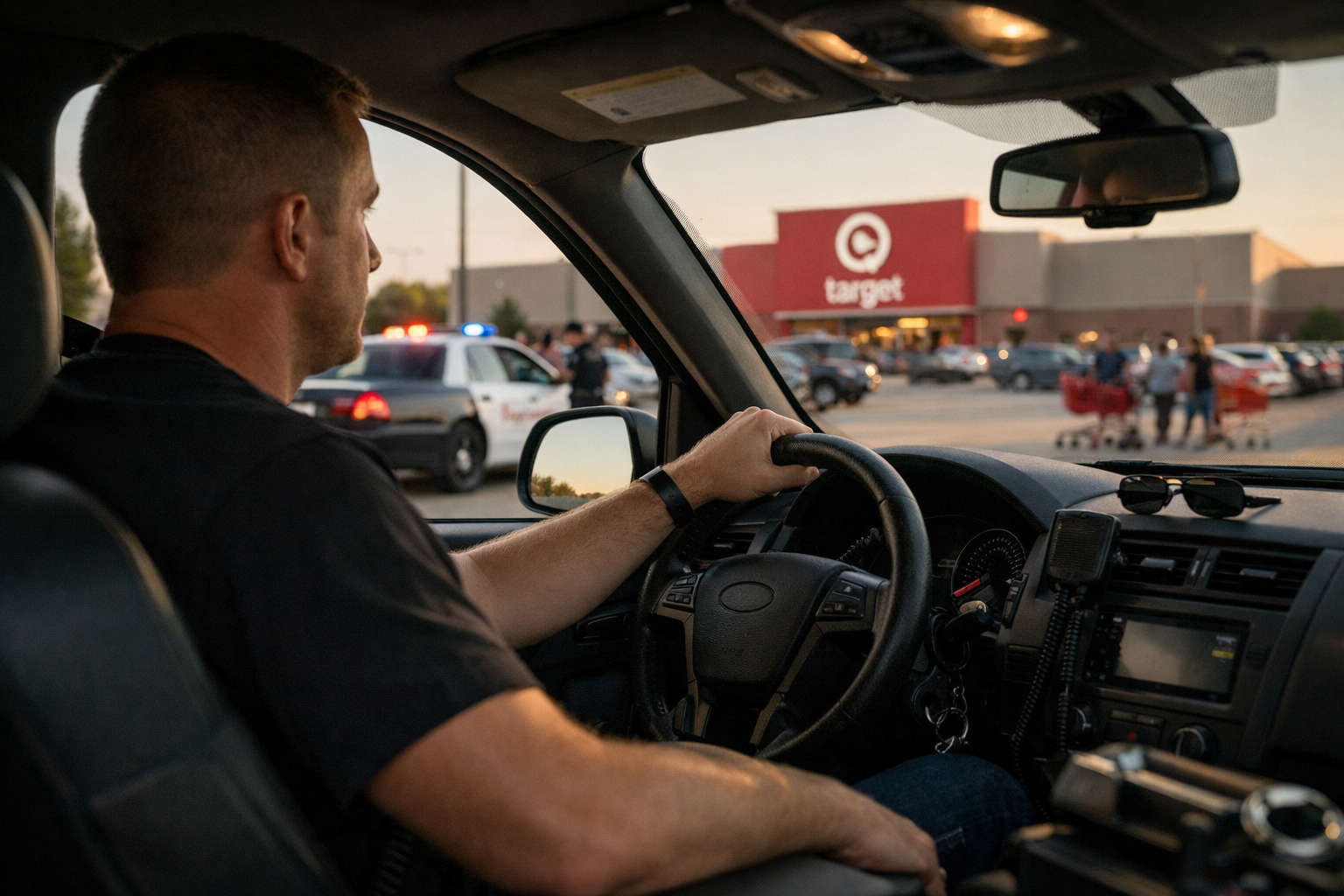
You know the feeling.
You're off duty. You just want to go to the grocery store, pick up something at Home Depot, grab a coffee without it becoming a thing. And without fully deciding to, you find yourself driving past the store in your jurisdiction — the one that's closer, the one that makes more sense logistically — and heading to the one one town over. Or two towns over. Or the one in the county where nobody knows your face and you can just be a person standing in a checkout line.
Maybe you've never said it out loud. Maybe it feels small or slightly embarrassing compared to the things the job actually does to people. Maybe you've rationalized it as just a preference, just convenience, just not wanting to deal with it today.
But it's not really about the store.
It's about what happens in your own jurisdiction when you try to exist as a civilian. The guy who makes eye contact a beat too long and you spend the next ten minutes running a threat assessment you didn't ask for. The person who recognizes you and wants to talk about that call, or the ticket, or the thing their neighbor did, or just to register that they know who you are. The low-level vigilance that doesn't turn off when the uniform comes off because the environment that requires it hasn't changed — you're still in the same geography, surrounded by the same people, carrying the same associations in their minds and apparently in your own nervous system too.
Driving to the next county is not avoidance in the clinical sense. It is a completely rational adaptation to a real environmental condition. This article is about what that condition actually is, why it produces the behaviors it produces, and what to do when the adaptation starts costing more than it's worth.
What the Nervous System Is Actually Doing
The off-duty vigilance that makes your own jurisdiction feel like an extension of the job is not a mindset problem. It is not a failure to decompress or a sign that you're doing something wrong psychologically. It is your nervous system doing exactly what it has been trained to do, in an environment that keeps providing the inputs that activate it.
The human nervous system learns context. It associates environments, faces, sensory cues, and social dynamics with specific threat levels and appropriate response states. Over time, with enough repetition, those associations become automatic — the nervous system reads the environment and sets its activation level before conscious thought gets involved.
For officers who live and work in the same jurisdiction, the environment of daily life has become inseparable from the environment of the job. The same streets. The same stores. The same faces — some of whom you've arrested, some of whom you've responded to in crisis, some of whom you've had to deliver news to that changed their lives. The nervous system has learned that this geography requires a certain level of activation, a certain quality of attention, a certain readiness — and it provides that activation automatically, whether you are in uniform or not.
This is not hypervigilance in the pathological sense, necessarily. It is conditioned contextual arousal. The context is activating. Removing yourself from the context — driving to the next county — removes the activating inputs and allows the nervous system to downregulate into something that actually resembles being off duty.
That is not avoidance. That is environmental management. And it works, which is part of why it persists.
The Specific Things That Happen In Your Own Jurisdiction
The grocery store avoidance is the most common version but it is not the only one. Once you name the underlying mechanism — conditioned contextual arousal in a jurisdiction where the job and civilian life share the same geography — you start to see it producing a whole range of adaptations that most officers have normalized without examining.
The threat assessment that runs automatically. You are standing in a parking lot and a man is sitting in a car that has been there too long. You are at a restaurant and someone at another table keeps looking over. You are at your kid's school event and you clocked the exits when you walked in and you are tracking the energy in the room with a part of your attention that was not invited. This is not paranoia. It is a trained perceptual system doing what it was trained to do in an environment that provides enough familiar inputs to keep it running.
The recognition that changes the interaction. Someone places your face — from a call, from a traffic stop, from the news, from just knowing you're local law enforcement — and the interaction shifts. They become either deferential in a way that feels like performance, or edgy in a way that requires management, or they want something from you — information, reassurance, a complaint lodged informally — and you are standing in a coffee shop in civilian clothes at 9am on your day off and you are suddenly, again, on the job.
The personal information exposure that comes with being known. Living in your jurisdiction means people know things about you — where you shop, what your car looks like, where your kids go to school, what your family looks like. For most people this is just community. For an officer who has made enemies in the course of doing the job — and almost every officer has, regardless of how well they do it — this is a different kind of exposure. The next-county Target is not just about avoiding awkward interactions. Sometimes it is a genuine, reasonable security consideration.
The inability to fully downregulate at home. If the neighborhood around your house is in your jurisdiction, the off-duty environment never fully becomes a rest environment. The drive home is through the same streets. The neighbors are the same people. The activation cues are ambient and continuous. The nervous system never gets a clean signal that the threat-relevant context has ended, because geographically it hasn't.
When the Adaptation Is Healthy and When It Isn't
Driving to the next county to do your grocery shopping is fine. It is a low-cost adaptation that gives your nervous system a genuine break and asks essentially nothing of you beyond fifteen extra minutes in the car. If it works, use it. There is no professional or psychological obligation to white-knuckle your way through your local Walmart in the name of not avoiding things.
The adaptation starts becoming worth examining when the cost of it grows beyond what it's giving back.
When the radius of where you feel genuinely off-duty keeps expanding. When one county over becomes two counties over becomes only feeling okay when you are far enough away that no one could possibly know you. When the vigilance that used to turn off in the next county is now following you there too. When you are declining things — events, gatherings, opportunities — not because the next-county version isn't available but because the effort of going anywhere at all has started to feel like more than it's worth.
When the off-duty adaptation has stopped being about managing a specific environmental trigger and has become about managing a persistent internal state that the environment is no longer primarily responsible for producing — that is when the adaptation is telling you something that deserves attention.
The distinction matters because the intervention is different. Environmental management — changing the inputs to give the nervous system a break — works when the problem is primarily environmental. When the nervous system has become the problem, changing the environment provides temporary relief but does not address what is actually happening.
The Thing Nobody Talks About: It Affects the People Around You Too
The off-duty vigilance that produces next-county grocery runs does not stay contained to your behavior. It shapes the texture of life for the people you live with in ways that accumulate quietly over time.
Your partner learns to read which version of you comes home. Your kids learn that dad or mom is different when they're in certain places — more alert, less present, quicker to scan the room. Family outings in the home jurisdiction carry a different quality than family outings elsewhere. The family vacation where you finally, visibly relax is also a data point about what it has been costing everyone that relaxed version of you to not be available closer to home.
None of this is a criticism. It is a description of a real pattern that deserves to be named — because unnamed patterns in families accumulate into things that are harder to address than the original mechanism that produced them.
The people who live with officers often have a clearer view of the off-duty activation pattern than the officers themselves, because they are watching it from the outside. If your partner has ever said something like "you always seem lighter when we're away" or "you're different here than you are at home" — they are describing the conditioned contextual arousal pattern with more precision than most wellness frameworks use.
What to Do With This
The goal is not to stop driving to the next county. The goal is to understand what you are managing, to make the management deliberate rather than automatic, and to catch it early if the adaptation starts costing more than it's providing.
Name it to yourself
You drive to the next county because your jurisdiction activates your nervous system in a way that does not resolve when you take the uniform off, because the environment that requires vigilance and the environment of your daily life are the same environment, and your nervous system has not found a way to run two different programs in the same geography. That is a real thing with a real mechanism. It is not weakness. It is not a sign that something is fundamentally broken. Naming it accurately is the first step toward managing it deliberately.
Create genuine off-duty environments deliberately
The next-county grocery run is an intuitive version of this — you are creating an environment with fewer activation cues. You can do this more deliberately and more completely. Identify the places, the activities, the social contexts where the activation genuinely turns down — where you are actually off duty rather than performing being off duty. Protect those contexts. Invest in them. They are not luxuries. They are the physiological recovery the job requires and does not provide on its own.
Notice the radius
Pay attention to whether the geography of where you feel genuinely off-duty is stable or expanding. A stable radius — the next county works, has always worked, continues to work — is a manageable adaptation. An expanding radius is a sign that the internal state is changing in ways that the environmental management is no longer keeping up with. Expanding radius warrants a conversation with someone qualified to help assess what is actually happening.
Talk to your family about it
Not a formal conversation necessarily — just an acknowledgment that they are probably already aware of. "I know I'm different when we're out of town. Here's why that is." Naming the mechanism to the people who live with it converts something they have been adapting around silently into something that can be talked about. That conversation changes the family system's relationship to the pattern even if it does not immediately change the pattern itself.
Bring it up with a peer support officer or therapist
Not because driving to the next county is a clinical problem. Because the off-duty activation it represents is worth monitoring, and because the person best positioned to notice if it starts trending toward something that warrants more attention is someone who understands the mechanism and is checking in regularly. Peer support and law enforcement-experienced therapists see this pattern constantly. You will not be describing something they have not heard before. What they can offer is a calibrated outside view of whether what you are managing is stable or shifting.
The Last Thing
The next-county Target run is one of the smallest, most ordinary expressions of what this job does to the people who do it. It barely registers as a wellness concern. It is easy to rationalize and easy to dismiss and easy to never examine because it works well enough and costs little enough that there is no immediate pressure to look at it.
But it is pointing at something real. The inability to fully inhabit your own civilian life in your own community is a cost. It is a cost that compounds quietly, over years, in ways that show up in family life and in the texture of what being off duty actually feels like and in the slowly expanding radius of where you have to go to find it.
You are allowed to name that cost. You are allowed to take it seriously even though it looks, from the outside, like just a preference for a particular grocery store.
It is not just a preference for a particular grocery store.
ThreatReady LE publishes weekly intelligence on threat recognition and trauma-informed practice for law enforcement. Subscribe free at threatreadyle.com.
Frequently Asked Questions
Is driving to the next county to avoid my jurisdiction actually a problem, or is it just a reasonable coping strategy?
Both, depending on how it's functioning. As a low-cost adaptation that gives your nervous system a genuine break from a genuinely activating environment — it's fine. Use it. There is no psychological obligation to force yourself through environments that keep your nervous system on duty when the point is to be off duty. It becomes worth examining when the radius of where you feel genuinely off-duty keeps expanding, when the vigilance is following you to the next county too, or when you are declining things not because the alternative isn't available but because the effort of going anywhere has started to feel like more than it's worth. The behavior itself is not the problem. What it's telling you about your internal state is worth monitoring.
My partner has noticed I'm more relaxed when we travel. Should I be worried about that?
Not necessarily worried — but it is worth paying attention to as data. Your partner is observing the conditioned contextual arousal pattern from the outside, which often gives them a clearer view of it than you have from the inside. The fact that you relax visibly when you leave your jurisdiction is confirmation that the mechanism described in this article is operating in your life. What matters is whether that pattern is stable — you relax when you travel, you manage okay at home, the radius of where you feel off-duty is not expanding — or whether it is shifting. If your partner's observation is that you used to relax when you left the county and now you only relax when you leave the state, that shift is worth taking seriously. If it's stable and the people around you are okay and you are okay, name it and monitor it.
I've been doing this for so long I don't even notice the vigilance anymore. Is that better or worse?
It depends on what not noticing means. If the vigilance has become so well-managed and so efficiently calibrated that it runs in the background without consuming significant cognitive or emotional resources — that is a form of expertise, and it is probably fine. If not noticing means the vigilance has become so ambient and continuous that you have lost the ability to detect when it is running and when it isn't — that is a different situation. The test is what happens in environments where you used to feel genuinely off-duty. If those environments still produce genuine downregulation — lower activation, actual rest, the felt sense of being a civilian rather than an officer — the habituation is probably working for you. If genuine downregulation has become difficult to access anywhere, the fact that you don't notice the vigilance anymore is not reassurance. It is the absence of a signal that used to tell you something important.
What if I actually live in my jurisdiction and can't avoid it — I can't just move?
Most officers can't, and this article is not suggesting you should. The next-county adaptation is one tool, not the only tool, and its value is in what it represents — deliberately creating environments with fewer activation cues — rather than in the specific geography. You can apply the same principle within your jurisdiction in ways that don't require driving an hour to go grocery shopping. Identifying the specific contexts within your jurisdiction that activate least — the parts of town, the times of day, the types of venues — and prioritizing those for off-duty time is a version of the same environmental management. The goal is deliberate creation of low-activation contexts, not geographic escape. Geographic escape is just the most intuitive version of it.
How do I know if what I'm experiencing is normal occupational adaptation or something that needs clinical attention?
A few specific indicators are worth using as a rough screen. First, functionality — is the off-duty vigilance interfering with your ability to do the things that matter to you, or is it an inconvenience you work around without significant cost? Second, trajectory — is it stable, improving, or getting worse over time? Third, reach — is it contained to your jurisdiction and professional context, or is it spreading into environments and relationships that have nothing to do with the job? Fourth, physiology — are you sleeping, eating, and maintaining basic physical health, or are those things deteriorating? If the answers to those questions are reassuring — it is manageable, stable, contained, and not affecting your physical health — you are probably in the range of occupational adaptation that peer support and self-management can address. If any of those answers are concerning, that is the signal for a conversation with someone qualified to assess what is actually happening.
My kids have started to notice that I'm different in certain places. How do I talk to them about it?
Age-appropriately and honestly, without transferring the weight of it to them. Young children do not need the mechanism explained — they need reassurance that they are safe and that the way you are in certain places is about your job, not about them or anything they did. Something like: sometimes my job brain keeps running even when I'm not at work, and it makes me more alert in some places than others. It doesn't mean anything is wrong. Older kids and teenagers can handle more of the actual explanation — that your nervous system has learned to be alert in certain environments because of the work you do, and that it takes time and distance for it to turn off. What matters most is that they are not left to construct their own explanation for why you are different in certain places, because the explanations children construct in the absence of information are almost always worse than the truth.
Is this connected to PTSD or is it something different?
It can exist on a continuum with PTSD but it is not the same thing, and the distinction matters for how you address it. Conditioned contextual arousal — the nervous system activating in environments associated with the job — is a normal feature of any high-stress occupational conditioning. It is not, on its own, a trauma response. PTSD involves a specific cluster of symptoms — intrusion, avoidance, negative alterations in cognition and mood, hyperarousal — that are persistent, distressing, and functionally impairing in ways that go beyond manageable occupational adaptation. The off-duty vigilance described in this article can be a feature of PTSD, but it can also exist independently of it. If the vigilance is accompanied by intrusive memories, nightmares, emotional numbing, persistent negative beliefs about yourself or the world, or significant functional impairment — that constellation warrants a clinical assessment rather than just self-management strategies.
What does it actually feel like when the nervous system genuinely downregulates — how do I know if I'm actually off duty versus just less activated?
This is a more important question than it might seem, because officers who have been running at high activation for long periods sometimes lose the felt sense of what genuine downregulation actually is. Genuine downregulation feels like a specific physical shift — a softening of muscle tone, a slowing and deepening of breathing, a quality of attention that is broad and soft rather than narrow and scanning, an absence of the background monitoring that runs continuously in activating environments. It often has a slightly drowsy quality initially, which can feel uncomfortable or even wrong to people who have associated alertness with safety for long enough. If you cannot remember the last time you felt that shift — if off duty feels like less activated rather than actually different — that is worth naming to a peer support officer or therapist. The inability to access genuine downregulation is itself a clinical indicator, not just an inconvenience.