Your Patrol Vehicle Is Not a Bunker. Here's How to Use It Like It Is One.
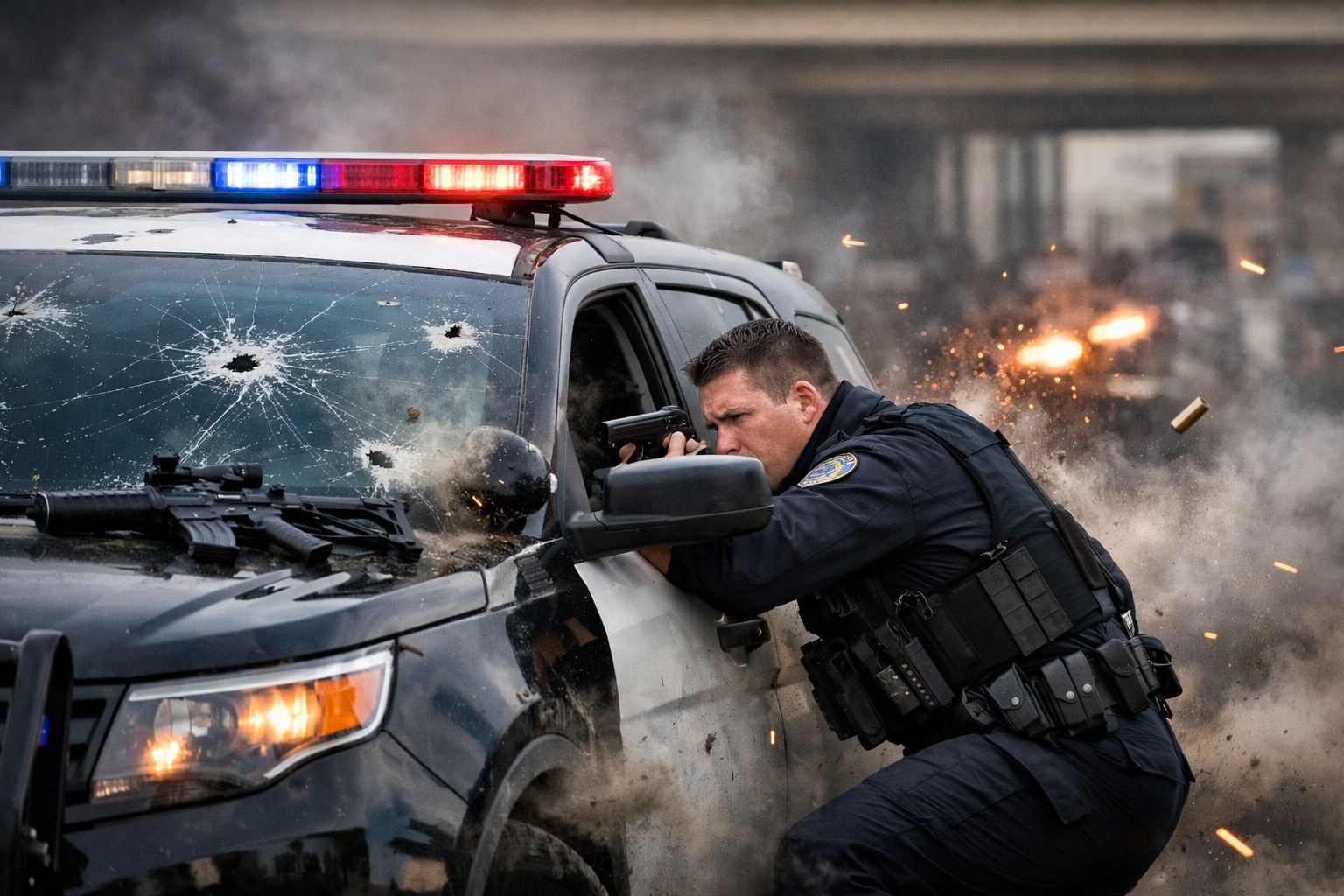
What officers actually need to understand about using vehicles for cover — and why mobility beats position every time
There's a default assumption that gets officers hurt in gunfights: the idea that reaching cover means the hard part is over.
It isn't.
A patrol vehicle can stop rounds. It can buy time. Used correctly, it's a genuine tactical asset. But the research on officer-involved shootings, combined with what trainers who've spent decades in the field are teaching, tells a consistent story: officers who lock onto cover and stop moving are making a choice that works against them — often without realizing it.
This piece isn't about tactics for their own sake. It's about the specific cognitive and behavioral patterns that drive officer decision-making under fire, and what the data says about how those patterns are playing out.
The Cover Instinct Is Real — and Partly Wrong
When a gunfight starts, seeking cover is the right instinct. That part is correct. The problem is what happens next.
Under extreme stress, the human nervous system doesn't distinguish between "behind cover" and "safe." The relief of reaching a physical barrier — the engine block, the door, the rear quarter panel — activates a threat-reduction response that can translate into stillness. The brain reads "I found protection" as "the danger is reduced." It isn't, necessarily. But that's the signal the autonomic nervous system sends.
The tactical consequence of that signal is that officers stop moving. They lock in behind cover, reduce their own mobility, and unintentionally hand a significant advantage to the suspect.
This is not a character flaw or a failure of courage. It's a predictable neurological response to a high-threat environment, and it needs to be trained against specifically.
What Happens When You Stop Moving
When an officer cements behind a piece of cover, the suspect gets information. They can track where the officer is. They can adjust their aim — rounds going low become rounds going higher, potentially skipping off a hood or deforming through a pillar and catching an officer in the face, arms, or neck. The suspect also starts closing distance.
The officer who is stationary has effectively surrendered the element of unpredictability. They've made themselves a fixed problem for the suspect to solve.
Mobility inverts that dynamic. An officer who is moving — staying off the vehicle, maintaining distance from the cover itself rather than pressing against it — is harder to track, harder to aim at, and forces the suspect to continuously reacquire a target. When the suspect loses visual contact, they have to move too. And a moving suspect is a suspect who is no longer in a stable firing position.
This is why experienced trainers emphasize getting a step or two away from the vehicle rather than hugging it. Distance from cover maintains the option to maneuver. It means that if rounds start deflecting or skipping, you're not in the path of the ricochet. And it means you can shift to a better angle, transition to the next piece of cover, or create the geometry needed for an effective shot.
The Part Nobody Wants to Say Out Loud
Law enforcement has done a reasonably good job over the past few decades of refining vehicle cover tactics. But there's a harder conversation underneath the tactical one.
Officer hit rates in active gunfights are, by most analyses of FBI data, somewhere in the range of 10 to 20 percent. For every ten rounds fired in a real engagement, eight to nine don't connect. And the rounds that do connect tend to hit lower on the body — legs, stomach — rather than the center mass that would stop the threat most efficiently.
That's not primarily a tactics problem. Tactics matter — the decision to move, to create distance, to get out of the cone of fire — but you can execute every tactical principle correctly and still not be able to put rounds on target under stress if your shooting isn't trained to that level.
The body-worn camera record of officer-involved shootings frequently shows what trainers describe as frantic firing — high volume, low control, driven by adrenaline and the urgency of the situation rather than by accurate, deliberate shooting skill. That pattern isn't unique to undertrained officers. It shows up across experience levels when the physiological response to extreme threat overwhelms the skill that was built in static range environments.
The uncomfortable implication is this: many departments train their officers to shoot well on a line, at a static target, with no time pressure and no threat. Then they're surprised when that training doesn't hold under conditions that bear no resemblance to how it was built.
Where the Gunfight Actually Starts
Most vehicle-related gunfights don't begin with an officer already behind their patrol car in a prepared position. They begin with an officer beside a suspect's vehicle — often 15 to 17 yards away from their own car — at a traffic stop.
That distance matters enormously. Running back to the patrol vehicle when a gunfight erupts doesn't just take time. It gives the suspect a predictable target moving in a straight line away from them, time to steady their aim, and a clear read on exactly where the officer is going. The officer has just handed control of the engagement to the other person.
The instinct to retreat to your own vehicle — to the thing you know, the thing that's yours — is understandable. It's also often wrong. The suspect's vehicle, already within arm's reach, is cover now. The patrol car, 50 feet away, is cover later, if it's reachable at all.
Movement to the rear of the nearest vehicle — breaking out of the direct line of fire — buys time, creates angles, and keeps the officer in the fight. From there, moving to the patrol vehicle becomes a possibility rather than a sprint across open ground.
What the Pillars Are Actually Good For
Vehicle pillars — A, B, and C — get talked about in two different ways in training circles. Some instructors downplay them because rounds do go through them. Others treat them as reliable protection. The more accurate framing is that they are transitional cover, not hard cover.
A pillar, B pillar, C pillar — none of them are positions to defend. They're positions to shoot from briefly while you're moving to something better. If you're transitioning from the engine block to the rear of the vehicle and you pick up a shot opportunity at the B pillar, take it. Then keep moving. The pillar bought you a moment and an angle. It was never meant to be where you stay.
This reframe matters psychologically as much as tactically. Officers who understand that they're always in transition — always moving toward a better position — are less likely to get locked into one piece of cover and stay there until the situation deteriorates around them.
The Electric Vehicle Question
This is worth addressing briefly because the patrol fleet is changing. EVs are still rare in active patrol roles, but that's shifting in some jurisdictions, and the tactical implications are real.
The engine block — dense, heavy, mechanically complex — is the most reliable cover a standard patrol vehicle offers. EVs don't have one. The front of an EV is a frunk over a battery pack and motor assembly. The ballistic profile is fundamentally different.
The core principles don't change: put as much of the vehicle as possible between you and the threat, maintain mobility, don't cement. But officers transitioning to EV platforms need to understand that the cover they'd normally count on in the front third of the vehicle may perform very differently than what they're used to. A lot will depend on what's actually in the vehicle — gear, equipment, the battery configuration — and how rounds interact with those materials. This is an area where agencies adopting EVs should be doing live-fire vehicle testing, not assuming that doctrine built around V8 Crown Vics and Chargers transfers cleanly.
What This Means for Training
The pattern that runs through all of this is the same one that runs through most survivability research: the gap between what officers are trained to do and what they're capable of doing under the specific physiological conditions of a real threat encounter.
Static range qualification does not build the neural pathways that hold under extreme stress. Performance-based training — moving while shooting, shooting from behind vehicles, engaging targets that move, operating under time pressure — builds different pathways. The difference shows up in the body camera footage, and it shows up in the data on officer survivability.
Departments that prioritize realistic, dynamic firearms training produce officers who shoot better when it matters. That's not a complicated finding. It is, for many agencies, an expensive and logistically difficult one to act on.
But the alternative is continuing to send officers into gunfights with skills built for a range that doesn't look anything like the street they work.
The Bottom Line
A patrol vehicle is a tool. It's cover, not safety. The distinction sounds small. Under fire, it's the difference between an officer who keeps moving, keeps thinking, and stays in the fight — and one who locks down, waits, and lets the suspect control the clock.
Mobility is the principle. Shooting is the skill. Cover is just what you use while you're working both.
ThreatReady LE presents research-backed and field-informed content for educational purposes. This article does not constitute professional tactical or use-of-force training. Always follow your department's policies and consult qualified instructors for vehicle tactics and firearms training.
Frequently Asked Questions
Is a patrol vehicle actually capable of stopping bullets?
Some parts of it are, under some conditions. The engine block — the densest concentration of mass in a standard patrol vehicle — can absorb and deflect rounds, particularly at common handgun calibers. Other parts of the vehicle, including glass, doors, and pillars, offer significantly less protection. Rounds can and do penetrate A, B, and C pillars. Cover from a vehicle should always be treated as temporary and situational, not guaranteed.
What part of a patrol vehicle offers the most protection?
The engine block is generally considered the most ballistically reliable part of a standard patrol vehicle because of its mass and density. The rear of the vehicle — when it contains heavy gear, spare tire, and equipment — can also absorb rounds in some circumstances. Glass and pillars offer limited protection and should be treated as transitional cover at best.
Why do trainers recommend staying away from the vehicle rather than pressing against it?
Distance from cover preserves mobility. When you're tight against a vehicle, you're committed to that exact position. A step or two off the vehicle means you can maneuver around it, change your angle, and avoid rounds that skip or deflect off the surface. It also keeps you out of the debris path of fragmenting rounds. Cover works best when you're using it as a tool rather than hiding behind it.
Why shouldn't an officer run back to their patrol car when a gunfight starts at a traffic stop?
At a typical traffic stop, the patrol car is parked 15 to 17 yards behind the suspect's vehicle. Running that distance under fire means moving in a straight, predictable line while the suspect has a clear, stable shot. The suspect's vehicle — which is already within close range — is the more tactically sound immediate cover. The patrol car may become reachable once the officer has created distance and established a position, but it shouldn't be the first move.
What is the "cone of fire" and why does it matter?
The cone of fire refers to the area in front of a weapon's muzzle, extending outward at roughly a 45-degree angle in each direction. An officer standing beside a suspect's vehicle on a driver-side approach is often well inside that cone. The immediate priority when a gunfight begins is to move out of that cone — typically toward the rear of the suspect's vehicle — rather than staying in the direct line of fire while drawing and engaging.
Why are officer hit rates in gunfights so low?
Analysis of FBI shooting data consistently shows officer hit rates in the range of 10 to 20 percent in real engagements. The primary factor isn't tactics — it's the gap between how officers train and the conditions of an actual gunfight. Static range qualification builds accuracy on a line, against still targets, without time pressure or physical stress. Real gunfights involve extreme adrenaline, moving targets, poor lighting, time compression, and fine motor degradation. Performance-based, dynamic training builds the skills that hold under those conditions. Most qualification programs don't.
Are vehicle pillars reliable cover?
Not as a sustained position. Rounds can penetrate A, B, and C pillars, particularly at rifle calibers and even with some handgun rounds depending on angle and velocity. Pillars are best understood as transitional cover — positions from which you can take a shot or maintain some protection while moving between more substantial cover. Staying at a pillar and treating it as a defensive position is a tactical error.
How does an electric vehicle change vehicle cover tactics?
The most significant difference is the absence of a traditional engine block. The front section of an EV — typically a frunk over a battery and motor assembly — has a different ballistic profile than the heavy, dense engine block of a gas-powered vehicle. The core principles remain the same: maximize the mass of the vehicle between you and the threat, maintain mobility, keep moving. But officers using EVs should not assume the front of the vehicle offers the same protection they'd expect from a traditional patrol car. Agencies adopting EV platforms should conduct live-fire testing to understand how their specific vehicles actually perform.
What kind of training builds better performance in vehicle gunfights?
Performance-based, dynamic training that involves moving while shooting, engaging from behind vehicles, working under time pressure, and encountering targets that move. This kind of training builds the neural pathways and muscle memory that hold under extreme stress. Static range qualification does not replicate the conditions of a real gunfight closely enough to build those skills reliably. Departments that invest in scenario-based, realistic firearms training see measurable differences in how their officers perform when it matters.