Where the American Public Actually Stands on Law Enforcement in 2026
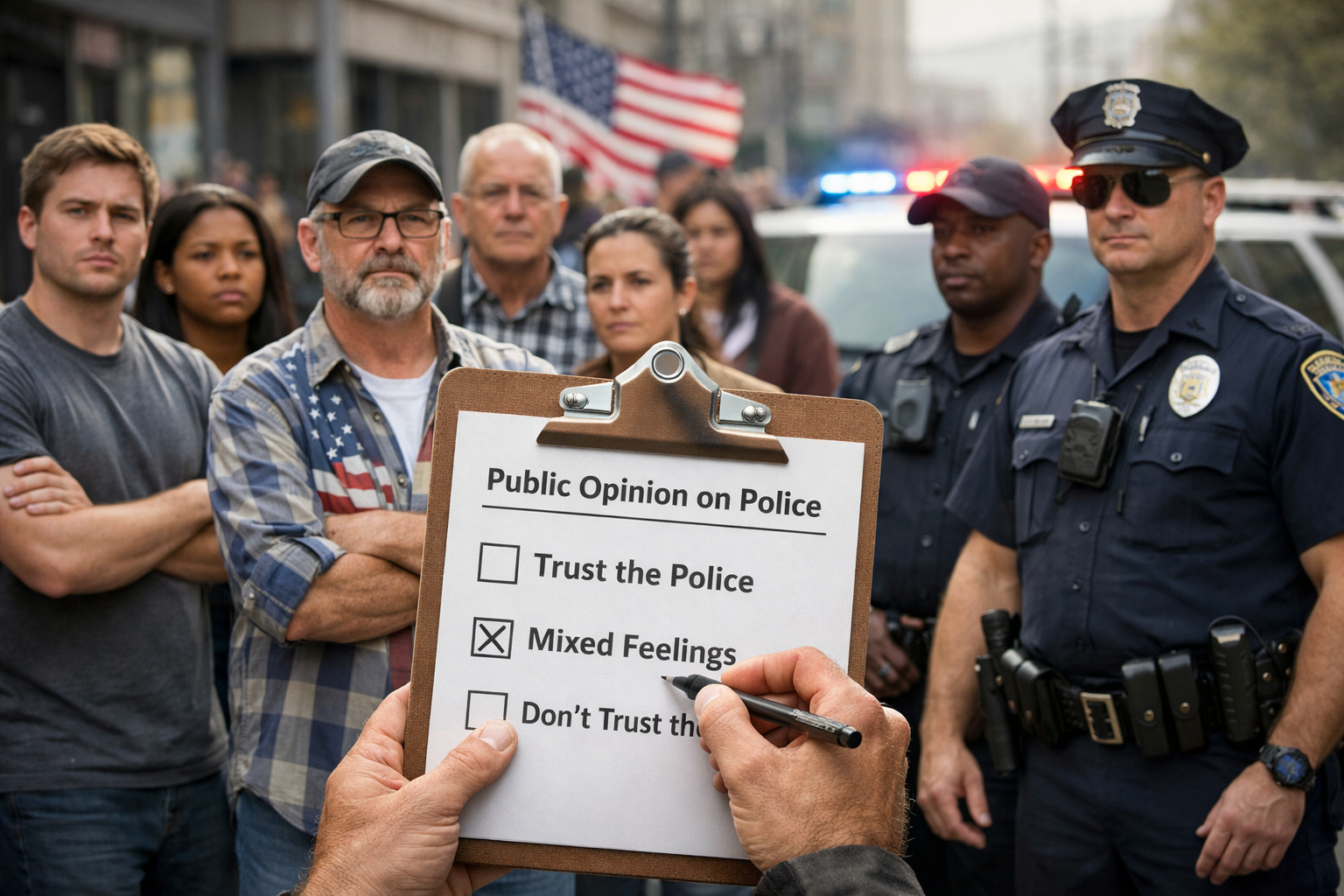
The data behind the headlines — public trust, generational gaps, officer safety numbers, and the workforce crisis reshaping policing
The story of public support for law enforcement is rarely told accurately. On one side, you hear that trust is collapsing. On the other, that everything is fine and the critics are wrong. The actual data is more complicated — and more useful — than either narrative.
Here's what the numbers say heading into 2026.
Public Confidence Is Recovering — But Unevenly
The post-2020 erosion of public confidence in police has been real, and so has the rebound.
A Gallup survey published in May 2025 found 74% of Americans report confidence in their local police — up from 71% in 2023. Police1 That's a meaningful increase, and it tracks across racial demographics in ways that matter.
Among Black Americans, confidence in local law enforcement climbed from 59% in 2021 to 64% by 2024. White respondents showed a slight dip over the same period, from 80% to 77%. Lexipol The convergence is notable — the gap that widened sharply after 2020 is narrowing, even if it hasn't closed.
When asked specifically whether they believed police would treat them with courtesy and respect, 75% of Black respondents said yes — up from 69% in 2021. Lexipol
On a broader institutional level, a Gallup confidence poll found that alongside small business and the military, police are one of only three institutions that still command majority-level confidence from Americans. Gallup That's a notable position to hold in an era when institutional trust across the board is historically depressed.
The trend line is positive. But it's not a victory lap. Perception still lags behind reality, and the gains are fragile.
The Generational Trust Gap Is the Biggest Long-Term Problem
The number that should concern law enforcement leadership most isn't the overall confidence figure. It's the generational breakdown underneath it.
While 70% of American adults overall express at least some trust in police, Gen Z adults come in at just 53% and millennials at 57%. By contrast, strong majorities of Gen Xers (74%), baby boomers (85%), and the Silent Generation (89%) report trusting police. PRRI
Within Gen Z, the picture is more complex than a simple "young people distrust cops" story. Among Gen Z adults aged 18 to 26, only 28% express a great deal or quite a lot of confidence in police. Among younger Gen Z teens still in K-12, that number is 48% — higher, but still well below older generations. Gallup
The partisan divide within Gen Z is stark: Republican Gen Z adults report 82% trust in police, while Democratic Gen Z adults come in at 45%. PRRI This means the overall Gen Z trust figure isn't uniform — it masks a significant internal divide driven more by politics than age alone.
What makes this a long-term issue is that these are the people who will make up the bulk of the adult public — and the pool of potential recruits — over the next two decades. The gap between how older Americans and younger Americans perceive law enforcement isn't just a poll number. It's the shape of the future relationship between agencies and the communities they serve.
A Skeptic Research Center survey found that over 40% of Gen Zers and nearly 30% of millennials believed that more than 1,000 unarmed Black men were killed by police in 2021 — a number that is dramatically higher than the actual figure. Police1 Misperception at that scale doesn't come from bad intentions. It comes from information environments that don't correct inaccurate narratives. And it has real consequences for trust.
Crime Is Seen as a Major Problem — But That Doesn't Automatically Translate to Support
An AP-NORC poll conducted in August 2025 found that two-thirds of the public consider crime in the United States a major problem, and 81% see it as a major concern specifically in cities. Ninety-six percent of Republicans and 68% of Democrats shared that view about urban crime. AP-NORC
High concern about crime doesn't automatically produce support for expanded law enforcement authority, though. When asked about federal control of large city police departments, only about half of Republicans supported it — and Democrats were broadly opposed to the idea of sending federal troops to cities at all. AP-NORC
The public wants safer communities. What they disagree about — often sharply, along partisan lines — is the mechanism.
Officer Safety: The Best Year in Decades, With a Serious Asterisk
The National Law Enforcement Officers Memorial Fund's 2025 year-end report found that total line-of-duty deaths fell to 111 — a 25% decrease from 148 in 2024, and a near-historic low. The last time officer fatalities were at a comparable level was 1943. National Law Enforcement Officers Memorial Fund
Firearm-related fatalities fell 15% from 2024, reaching the lowest level in at least a decade. Fox News
That's genuinely good news, and it likely reflects real progress: better trauma medicine, improved ballistic protection, and a growing emphasis on officer safety practices.
The asterisk is this: the Fraternal Order of Police reported that 347 officers were shot in the line of duty in 2025 — a slight increase from 342 in 2024. The FOP noted that since the start of 2021, over 2,000 police officers have been shot in the line of duty, and in 2025 there were 67 ambush-style attacks resulting in 90 officers shot and 22 killed. Fraternal Order of Police
Officers are surviving attacks at higher rates than before. They are not facing fewer attacks. Those are two very different things, and conflating them produces a false picture of officer safety.
The Workforce Crisis Isn't a Recruiting Problem — It's Bigger Than That
The staffing challenge in American law enforcement has been described as a recruiting problem for years. More recent analysis suggests that framing undersells how serious it is.
The National Policing Institute's outlook for 2026 described it not as a shallow applicant pool but as a full-blown workforce crisis threatening the operational readiness of agencies nationwide. National Policing Institute
An IACP survey of 1,158 agencies found that over 70% reported recruitment has become more difficult compared to five years ago, with agencies operating at an average of 91% of authorized staffing levels. Lexipol
Major cities are seeing staffing gaps in the hundreds: Chicago is short well over 1,300 officers, Los Angeles over 1,000, Philadelphia approximately 1,200, and New York City over 3,000. American Police Beat
The causes are layered. Top reasons for early resignations include higher pay at other agencies, better career growth opportunities, dissatisfaction with policing as a career, and work-life balance concerns. Lexipol A tight labor market gives younger workers real alternatives in ways that didn't exist before.
Some departments are lowering education requirements to widen the applicant pool. In early 2025, the NYPD reduced its college credit requirement for police academy entry from 60 credits to 24. The Dallas Police Department began allowing applicants with only a high school diploma and three years of full-time work experience to qualify. Stateline
Whether loosening standards helps or hurts in the long run is a legitimate debate. What's not debatable is that the pressure to make those decisions reflects how serious the supply problem has become.
The retention piece may be even more concerning than recruitment. Agencies are losing experienced, seasoned officers and leaders — the people who mentor others, lead through turbulent times, and carry institutional knowledge that cannot be rebuilt quickly. National Policing Institute
The Political Context Agencies Are Operating In
Law enforcement in 2026 is operating inside a political environment that is highly polarized and rapidly shifting. Immigration enforcement operations have put federal law enforcement in particular in the center of public debate.
The FOP has noted a significant increase in assaults against ICE officers specifically, including vehicle attacks and death threats, as enforcement operations have intensified. Fraternal Order of Police
The National Policing Institute flagged that even if crime doesn't rise in 2026, tension will — and agencies will need skill, strategy, and transparency to manage it. National Policing Institute The political atmosphere around policing is unlikely to stabilize in the near term, and agencies that aren't proactively building community trust are building the conditions for future friction.
Deepfakes and generative AI have added a new dimension to that challenge: fabricated videos of officers, synthetic audio clips, and manufactured incidents can now go viral faster than any correction. Agencies need rapid-response communication strategies that didn't exist five years ago. National Policing Institute
What This Means for the Officers Reading This
None of these numbers are abstract. They describe the environment officers are working in every day — the communities whose trust has been partially rebuilt and remains fragile, the generational divide that will shape policing for the next two decades, the staffing shortages that increase every individual officer's workload and stress, and the threat landscape that keeps producing attacks even as fatalities decline.
The picture in 2026 is genuinely mixed. Confidence in police is recovering. Officers are surviving attacks more often. But the workforce is depleted, the generational trust gap is real, and the political environment is volatile.
Understanding where the public actually stands — not where we wish they stood, and not the worst version of the narrative — is part of how law enforcement builds the relationships that make the job safer and more sustainable.
ThreatReady LE presents research-backed content for educational purposes. Data referenced includes polling from Gallup, AP-NORC, PRRI, and the Skeptic Research Center; officer safety data from the National Law Enforcement Officers Memorial Fund and the Fraternal Order of Police; workforce data from the International Association of Chiefs of Police and the National Policing Institute.
Frequently Asked Questions
How much confidence do Americans have in police in 2026?
Recent polling shows that public confidence in local law enforcement is recovering after the declines seen around 2020. A 2025 Gallup survey found that about 74% of Americans report confidence in their local police, up slightly from 71% in 2023.
While trust is improving, the rebound is uneven across demographics and age groups. Confidence remains stronger among older Americans and somewhat lower among younger generations.
Has public trust in police increased among Black Americans?
Yes, surveys indicate measurable improvement in confidence among Black Americans in recent years.
Polling data shows trust in local police among Black respondents rising from around 59% in 2021 to roughly 64% by 2024. Surveys also show increasing numbers of Black Americans saying they believe police will treat them with courtesy and respect.
Although gaps in perception still exist, the trust gap between racial groups has narrowed compared to the immediate post-2020 period.
Why is there a generational trust gap in policing?
One of the most significant trends in public opinion is the large difference in how younger and older Americans view law enforcement.
Gen Z adults report roughly 53% trust in police
Millennials report about 57%
Gen X adults report around 74%
Baby boomers report 85% or higher
Several factors contribute to this divide, including media consumption patterns, political polarization, and differing personal experiences with law enforcement.
Do younger Americans distrust police more than older generations?
In general, younger Americans report significantly lower levels of trust in law enforcement than older generations.
Among Gen Z adults aged 18–26, surveys show only about 28% report high levels of confidence in police, compared with strong majorities among older adults.
However, younger Americans are not a uniform group. Political affiliation plays a large role, with trust levels varying widely between conservative and liberal Gen Z respondents.
Do Americans believe crime is getting worse?
Many Americans say crime is a major national concern, even when crime rates fluctuate or decline in certain categories.
Polling shows roughly two-thirds of Americans consider crime a major problem, and more than 80% say it is a serious issue in large cities.
However, public concern about crime does not always translate into agreement about policing policies or law enforcement authority.
Are police officers facing more attacks in recent years?
Data shows a complex picture.
Overall line-of-duty deaths among officers declined significantly in 2025, reaching one of the lowest totals in decades. However, the number of officers shot in the line of duty has remained high, with hundreds of incidents reported annually.
This means officers are surviving more attacks due to improved medical care and protective equipment, but the frequency of violent encounters has not necessarily decreased.
Why are police departments experiencing staffing shortages?
Law enforcement agencies across the United States are facing a significant workforce crisis driven by several factors:
Declining recruitment pools
Increased early retirements and resignations
Competition from other careers offering higher pay or better work-life balance
Public scrutiny and political pressures
Many departments report operating below their authorized staffing levels, forcing agencies to adjust hiring requirements or expand recruitment strategies.
Are police departments lowering hiring requirements?
Some departments have adjusted hiring standards in response to staffing shortages.
For example, certain agencies have reduced college credit requirements or expanded eligibility criteria to increase the applicant pool.
Supporters argue these changes help address critical staffing needs, while critics worry about potential impacts on training, professionalism, and long-term performance.
How does politics influence public views of policing?
Public opinion about law enforcement is increasingly shaped by political identity and media environment.
Surveys show major differences between political groups when it comes to trust in police, crime policy, and federal involvement in local policing.
This polarization means that public debates about policing often reflect broader political conflicts rather than purely crime-related concerns.
What challenges will law enforcement face in the coming years?
Looking ahead, several structural challenges are likely to shape policing in the United States:
Generational trust gaps
Recruitment and retention shortages
Political polarization around public safety
New information challenges from AI and deepfake media
Changing expectations around transparency and accountability
How agencies respond to these pressures will play a major role in shaping public trust and the future of policing.