Code 3 and the Brain: What the Neuroscience of Emergency Response Driving Actually Tells Us
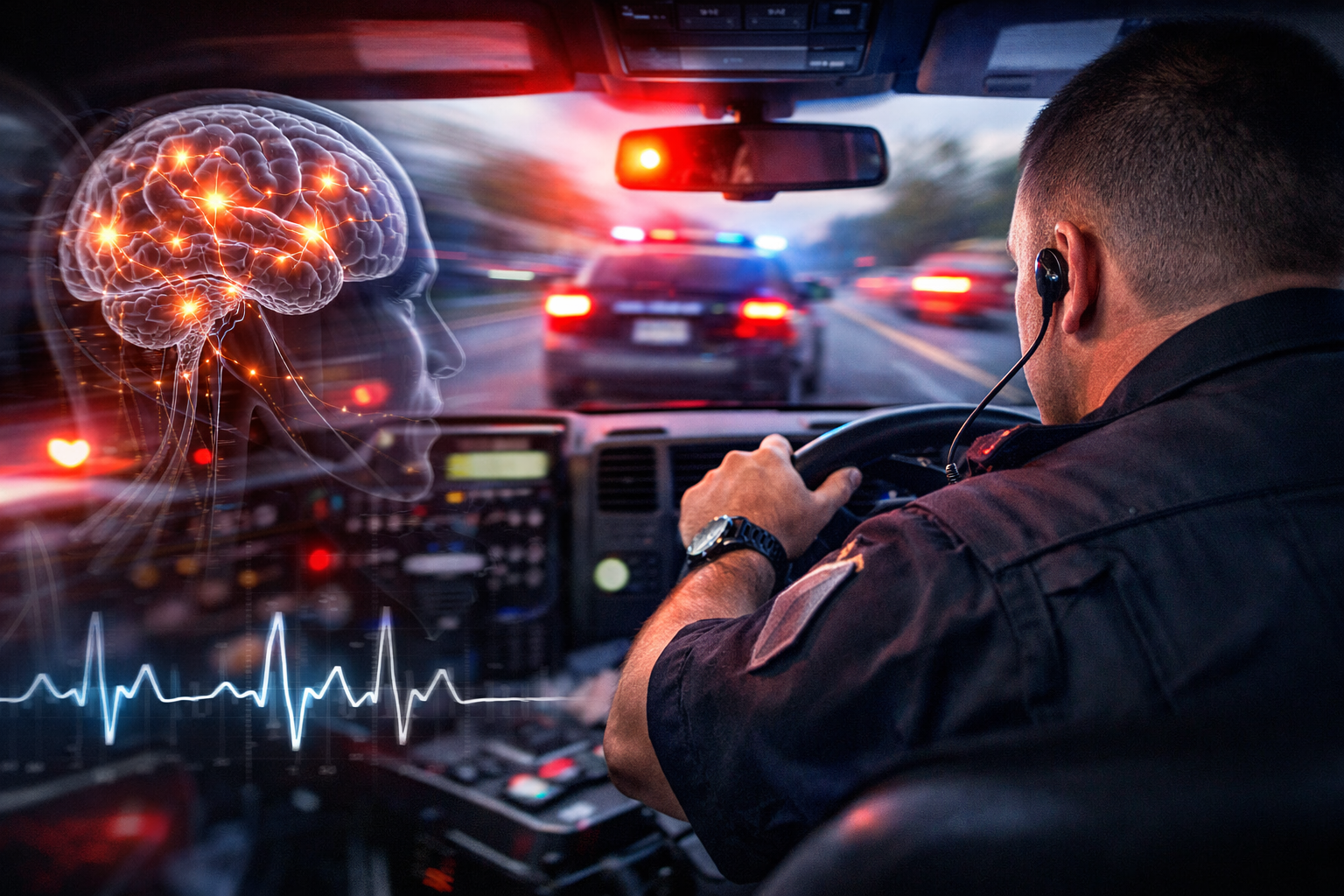
The call comes in. Lights on. Siren running. The needle climbs.
For most officers, that transition happens dozens or hundreds of times over the course of a career. It becomes routine in the sense that it becomes familiar. But familiarity isn't the same as safety, and the physiological and cognitive changes that happen inside an officer's brain and body the moment emergency status begins are anything but routine — whether it's the first time or the thousandth.
The research on emergency response driving sits at an intersection that doesn't get enough attention: the space between driving skill, cognitive load, physiological arousal, and decision-making under pressure. Understanding what's actually happening during a Code 3 response — neurologically, psychologically, and perceptually — produces better drivers and, more importantly, officers who come home.
The Arousal Problem Nobody Talks About in Driver Training
Every officer who has hit lights and sirens for the first time remembers the feeling. There's an activation response — heart rate climbs, attention sharpens, something that feels like readiness floods the system. It's the body interpreting the situation as high stakes and mobilizing accordingly.
This is the autonomic nervous system doing exactly what it's designed to do. The problem is that it doesn't always dose the response accurately. Sympathetic arousal — the physiological state that emergency driving triggers — optimizes the body for certain kinds of performance while actively degrading others.
At moderate levels, arousal improves reaction time and narrows attention to the task at hand. This is useful. At higher levels, the same system begins to produce tunnel vision, reduces peripheral awareness, impairs working memory, and compresses the range of behavioral options an officer perceives as available. The psychological literature describes this as the Yerkes-Dodson effect: performance improves with arousal up to a point, then declines as arousal continues to rise.
Emergency response driving tends to sit in that upper range of the arousal curve — especially for newer officers, and especially on high-stakes calls. The officer feels sharp and activated, which is subjectively difficult to distinguish from being cognitively impaired. But the cognitive profile at high arousal levels is meaningfully degraded compared to moderate arousal. Reaction time may actually increase. Decision-making quality drops. Risk perception narrows.
This is not a weakness or a failure of character. It is normal human neurobiology. The departments and academies that acknowledge it explicitly — that build training around managing arousal rather than pretending it isn't a variable — produce better emergency drivers than those that treat the psychological component as peripheral to the skill component.
Siren Hype Is a Real Phenomenon With a Physiological Basis
Among experienced driving instructors and officers who've thought carefully about this, there's a concept that comes up consistently: siren hype. The idea that activating emergency equipment creates a psychological shift that can push arousal past the optimal range and into territory where judgment is compromised.
This isn't folklore. It has a straightforward neurological explanation.
The siren itself is an auditory stressor — a loud, persistent, irregular sound designed to penetrate ambient noise and demand attention from everyone in earshot. That same auditory profile that makes it effective as a warning signal also activates stress response pathways in the officer running it. The sound that's supposed to clear the road is simultaneously elevating the driver's heart rate and cortisol levels.
Add to that the cognitive framing of the call itself. An officer responding Code 3 isn't just driving — they're pre-loading the mental model of what they're about to walk into. They're running through possibilities, anticipating what they'll need, managing radio traffic, and processing dispatch updates, all while navigating traffic at elevated speed. The cognitive demand is extraordinarily high.
The cumulative effect is that the officer arrives at the scene having spent the entire response in a high-arousal, cognitively loaded state. That has implications not just for the drive itself but for the quality of decision-making in the first minutes on scene — which is often when the situation is most fluid and most consequential.
Training that deliberately exposes officers to siren conditions, repeatedly and in controlled environments, accomplishes something important: it habituates the stress response. The auditory and situational triggers that initially spike arousal become familiar, which means the arousal response moderates over time. The experienced officer who drives Code 3 with a kind of practiced calm isn't suppressing their stress response through willpower — they've neurologically recalibrated through repeated exposure.
This is a learnable adaptation. But it has to be taught explicitly.
Perception and the Physics of Speed
Emergency response driving creates a perceptual problem that's worth understanding in some detail, because it operates below conscious awareness and directly contributes to crashes.
At higher speeds, visual processing changes in ways that feel imperceptible but are measurable and significant. The brain, managing the volume of incoming visual information at speed, compresses the useful visual field. Peripheral vision attenuates. Gaze tends to drop lower and closer — anchoring to the road immediately in front of the vehicle rather than scanning farther ahead.
This is maladaptive for exactly the situation it occurs in. At 80 miles per hour, the gap between where a driver's gaze lands and where the vehicle will be by the time any corrective action takes effect is enormous. An officer looking 100 feet ahead at that speed has approximately 0.85 seconds to process and respond to anything in that zone. An officer scanning 400 feet ahead has closer to 3.4 seconds — a difference that changes the entire calculus of what's avoidable.
The practical correction — deliberately pushing visual attention farther down the road — is simple to describe and genuinely difficult to execute under the arousal conditions of an emergency response. It requires active override of an automatic perceptual tendency. That override has to be practiced until it becomes its own automatic response, which is why experienced officers who've internalized it talk about it as a feeling — something the car and the road communicate when vision is right versus when it's dropped too close.
The same perceptual compression affects curve negotiation. An officer whose visual focus is dropped close will consistently underestimate how quickly a curve arrives and overestimate how much time they have to adjust speed. The "slow in, fast out" principle that driving instructors teach is partly about physics — weight transfer, tire traction, vehicle dynamics — but it's also about giving visual processing the time it needs to accurately read what the road ahead is doing.
Intersections as Decision Points, Not Just Physical Challenges
The intersection problem in emergency response driving is often framed as a driving skill issue. It is also, and perhaps more fundamentally, a decision-making issue.
The specific cognitive trap at intersections is the permission fallacy — the implicit assumption that lights and sirens convey right of way in a way that makes it safe to proceed. Legally, emergency vehicles are required to proceed through controlled intersections with caution regardless of what the signals say. Cognitively, the feel of emergency status can generate a subjective sense of authorization that doesn't map accurately onto the actual safety conditions.
What an officer actually has at a red light with lights and sirens running is a request to other drivers, not a guarantee. Whether that request has been received, processed, and acted upon is information the officer has to gather actively — through visual cues, through reading the behavior of vehicles in every approach lane, through slowing enough to verify rather than assuming.
This is harder than it sounds under high arousal conditions. The urgency driving the response competes directly with the caution required to clear the intersection safely. Experienced officers describe learning — usually through near-misses that they don't broadcast — that the intersection is where the willingness to slow down becomes non-negotiable. That the call on the other end doesn't get better if the responding unit doesn't arrive.
The cognitive reframe that helps here is one that experienced instructors teach explicitly: the intersection is where you ask permission, not where you assert priority. That reframe changes the internal experience of slowing, which shifts from feeling like a loss of urgency to feeling like the correct tactical decision.
Cognitive Load and the Distraction Problem Inside the Vehicle
Modern patrol vehicles are cognitively demanding environments under normal conditions. MDT screens, radio traffic, GPS, in-car cameras, communication with dispatch — the baseline demand on officer attention is substantial before the vehicle is moving at all, let alone at emergency speeds.
During a Code 3 response, every one of those demands competes with the driving task for the same limited attentional resources. The research on divided attention and driving is unambiguous: multitasking while driving is not a skill that improves with practice. It is a cognitive limitation that applies universally. What improves with practice is the ability to sequence demands — to consciously defer non-driving tasks to moments of lower driving demand, and to prioritize vision and vehicle control when demand is high.
The practical application is disciplined sequencing. Radio transmissions on straight stretches of road, not mid-intersection. MDT eyes during stops or reduced-speed moments, not during active navigation of traffic. Deliberate acknowledgment, internal or verbalized, that the driving task is primary and everything else waits.
This sounds straightforward. It conflicts directly with the urgency that emergency response generates — the pull to absorb more information about the call, to stay on top of radio traffic, to be cognitively prepared for what's coming. Managing that conflict is a skill that has to be developed consciously, because the intuitive response to urgency is to try to do more things simultaneously, not fewer.
The Experience Gap and What Departments Can Do About It
One of the most consistent findings across the research on emergency driving is that experience genuinely changes the cognitive and physiological profile of the response. Officers with more years on the road show more stable arousal levels during Code 3 driving, better maintained peripheral vision, more accurate risk assessment at intersections, and better sequencing of competing cognitive demands.
This isn't just skill accumulation. It's neurological adaptation — the same mechanisms that produce expertise in any high-demand domain. Repeated exposure in conditions that approximate the real thing produces a more calibrated stress response, a broader automatic skill base that frees up conscious attention for higher-order decisions, and a more accurate internal model of what the situation actually requires.
The problem is that the early period of an officer's career — when the experience gap is widest — is also when exposure to high-arousal driving situations is highest. New officers are in the field, responding to calls, before they've developed the neurological adaptations that make those responses safer. The gap between what the job asks and what their nervous system has learned to handle efficiently is at its widest precisely when it matters most.
Departments that take this seriously create structured mechanisms for bridging that gap faster. Pairing newer officers with experienced drivers who narrate their decision-making out loud. Creating opportunities to debrief near-misses without punitive consequence so that the learning from those events circulates. Running simulation-based or controlled driving scenarios specifically designed to expose officers to siren conditions, intersection decisions, and high-arousal driving in environments where mistakes are recoverable. And building a culture where senior officers share not just technique but the specific cognitive and physiological experiences — the siren hype, the perceptual compression, the pull toward multitasking — so newer officers can recognize them when they happen.
The knowledge that experienced officers carry about emergency driving is often tacit — felt and internalized but not easily articulated. Making it explicit, and transferring it deliberately, is one of the higher-leverage things a department can do for officer safety. The crash that doesn't happen on the way to the call is invisible in the data. The officer who arrives safely and in a state of appropriate readiness, rather than maxed out and cognitively spent, is better positioned for everything that happens next.
The Call That Warrants Code 3 Versus the Call That Doesn't
There's a category of emergency response decision that doesn't get enough attention in formal training: the decision of whether to run emergency status at all.
The legal authorization to respond Code 3 to a call and the tactical wisdom of doing so are not the same question. Officers are authorized to use lights and sirens in a wide range of situations. They are not equally necessary in all of them.
The cognitive trap here is status-based: emergency authorization feels like a directive to use it. The lights and sirens become defaults rather than tools. But experienced officers who've thought carefully about this recognize that response mode is a decision with real consequences — for the officer's cognitive and physiological state, for the risks imposed on other road users, and for the condition in which the officer arrives.
A high-arousal Code 3 response to a call that turns out to require a calm, methodical approach leaves the officer neurologically and physiologically mismatched to the task. The activation state that emergency driving produces doesn't dissipate instantly. Officers who routinely run emergency status on calls that don't require it are regularly arriving to scenes in states of arousal that are poorly calibrated to what the situation actually needs.
The experienced officer who knows the area, knows the call history, and makes a deliberate decision to roll without lights and sirens on a residential alarm isn't being casual about the job. They're exercising exactly the kind of calibrated judgment that the research and the experienced driving instructors consistently identify as the mark of a sophisticated emergency responder.
That judgment develops over time. It can also be modeled, discussed, and taught — which is part of what makes the experience gap discussion so important. The sooner newer officers understand that emergency response mode is a decision rather than a reflex, the sooner they develop the cognitive framework to make that decision well.
FAQs
Is emergency response driving actually more dangerous than other types of patrol driving?
Yes, measurably so. Vehicle crashes remain one of the leading causes of officer fatalities in the United States, and a significant portion of those crashes occur during emergency response or pursuit driving. The combination of elevated speed, high cognitive demand, physiological arousal, and the unpredictability of civilian traffic creates a risk profile that is substantially higher than routine patrol driving. This doesn't mean emergency response driving is unmanageable — it means it deserves the same level of deliberate training attention as any other high-risk tactical skill.
Why do newer officers tend to be at higher risk during emergency response driving?
The experience gap is primarily neurological. Experienced officers have developed habituated responses to the arousal triggers of emergency driving — the siren, the urgency of the call, the elevated speed — which means their stress response is more calibrated and their cognitive resources are less depleted during the response. Newer officers are navigating the same physiological activation without that habituation, while simultaneously managing a lower baseline of driving automaticity and a narrower mental model of what the road and other drivers are likely to do. The result is a higher cognitive load at exactly the moments when it's most costly.
What does the research say about multitasking while driving at speed?
The research is unambiguous and has been consistent across decades of study: there is no meaningful population of drivers for whom multitasking while driving at elevated speed does not degrade performance. The limitation is structural — attentional resources are finite, and dividing them between driving and any other cognitive task degrades both. What develops with experience is better sequencing — the ability to identify low-demand driving moments and concentrate non-driving tasks in those windows — not an actual ability to do both simultaneously without cost.
How should departments think about structuring emergency driving training?
The most effective approaches combine several elements: repeated exposure to siren conditions in controlled environments to habituate the arousal response; explicit instruction on the cognitive and physiological changes that emergency driving produces, so officers can recognize them; scenario-based practice at intersections and in curve negotiation with feedback; structured mentorship pairing that makes experienced officers' tacit knowledge explicit; and a culture that supports honest debriefing of near-misses without punitive consequence. Simulation technology has improved to the point where many departments can now create meaningful scenario fidelity without the safety risks of high-speed physical training — used well, it accelerates the experience that otherwise only accumulates over years.
What's the relationship between emergency driving performance and what happens on scene?
Closer than most training frameworks acknowledge. An officer who arrives at a scene after a high-arousal, cognitively demanding Code 3 response is not neurologically in the same state as an officer who arrived calm and methodically. The physiological activation of the drive carries forward into the first minutes of scene contact, which are often the most consequential. Departments that treat driving and scene performance as separate skill domains are missing the continuity between them. Training that includes transition — from high-arousal driving to the deliberate downshift required for effective scene management — addresses something real about how officer performance actually works.