The Patrol Vehicle as a Mirror: What 75 Years of Law Enforcement Cars Reveal About Policing Itself
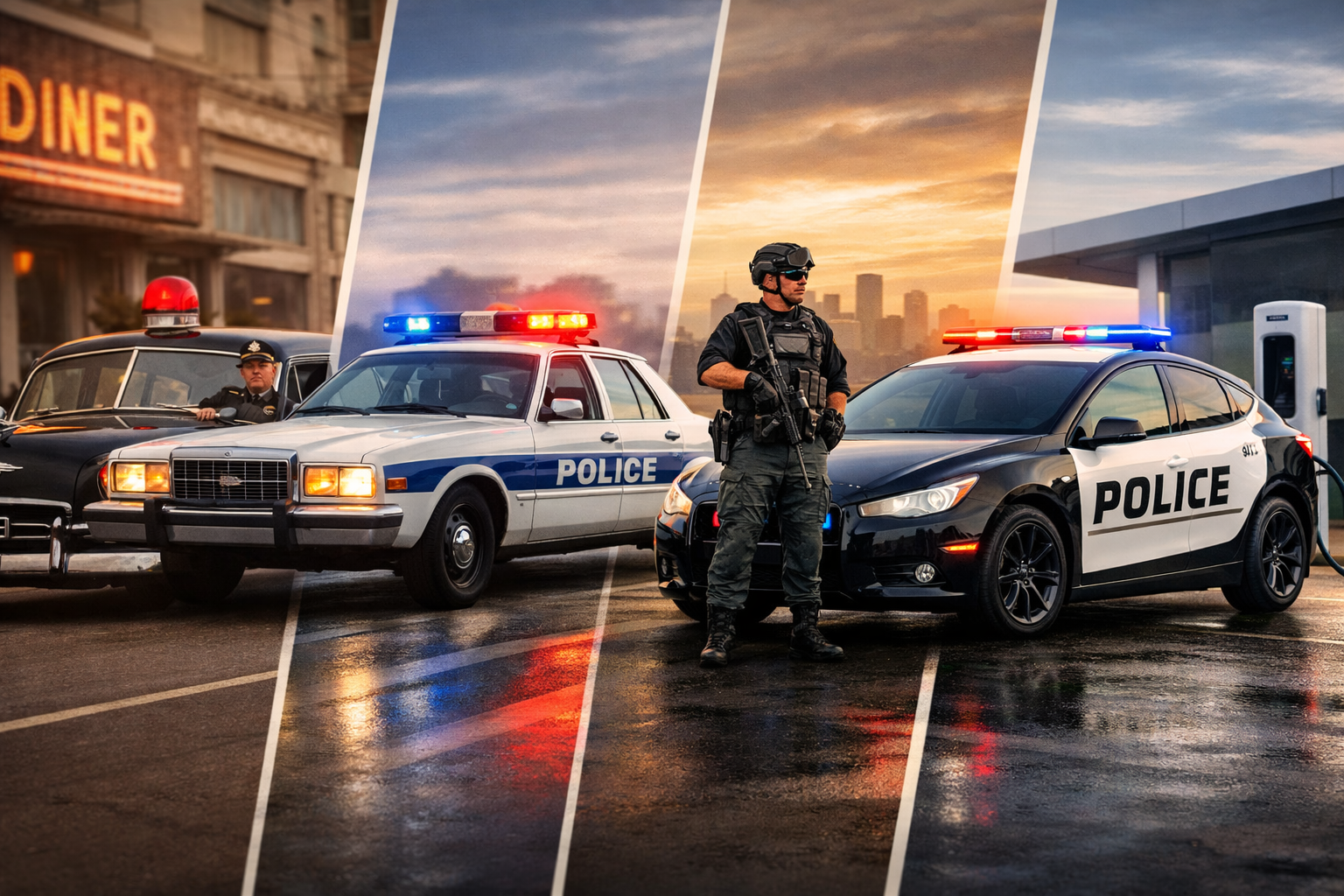
There's a version of this story that's just about cars. Engine displacements, horsepower figures, trim packages, model years. That version exists and it's interesting enough on its own terms.
But the deeper story of how the American patrol vehicle evolved from a modified civilian sedan into a purpose-built tactical and technological platform is really a story about how law enforcement itself changed — what it was asked to do, what it needed to survive, and what it prioritized at any given moment in American history. The vehicle was never just a vehicle. It was a material expression of how departments understood the job.
The Early Logic: Power, Reliability, and the Need to Chase
Before there were police packages, there was just the question of which civilian car could best survive the demands of law enforcement work. Reliability was the primary variable. Repairability mattered. And increasingly, in the early decades of the automobile, speed mattered.
The Ford V8 engines of the early 1930s became favorites among law enforcement for the same reason they became favorites among everyone else: they were powerful, they were relatively affordable, and they went fast. The irony that the same machines were popular with the criminal class — most famously with Bonnie and Clyde, who were killed in one — underscores something important about the era. Police and criminals were often driving the same cars, chasing each other in identical machines. The advantage went to whoever drove harder and knew the roads better.
That symmetry defined early automotive policing. There was no tactical doctrine built around the vehicle. It was transportation to the scene and, when necessary, a pursuit platform. The job it needed to do was essentially the same job a civilian driver needed it to do — just under more pressure and for more hours.
The Postwar Shift: When Departments Became Customers
The decision by Ford in 1950 to offer a dedicated police package — rather than simply selling departments whatever was in the civilian catalog — marked a meaningful inflection point. For the first time, law enforcement was being treated as a distinct use case with distinct requirements, not just as a bulk buyer of standard products.
What departments said they needed in 1950 was telling: power, durability, and enough electrical capacity to run the emerging technology of two-way radio. That last requirement is easy to overlook, but it represents something significant. The patrol vehicle was beginning to become a communications platform. Officers needed to be reachable, deployable on command, and in contact with dispatch throughout their shift. The car wasn't just moving them around anymore — it was keeping them connected to the broader operational picture.
The police package concept — purpose-built electrical systems, heavy-duty suspension and brakes, performance-tuned engines — established the template that has defined law enforcement vehicle procurement ever since. Agencies began specifying rather than just purchasing. The relationship between manufacturer and department became collaborative, at least in aspiration.
The Muscle Era and What It Said About Priorities
The 1960s were the peak expression of performance as the dominant value in patrol vehicle design. Horsepower climbed steadily. Top speeds pushed past 100 mph. Ford alone was offering more than two dozen law enforcement vehicle configurations by the early part of the decade, built on multiple platforms and targeting different agency needs.
This wasn't purely about pursuit capability, though that was part of it. It also reflected the broader American automotive culture of the era, in which performance was the primary measure of value. Departments wanted powerful cars partly because powerful cars were what you wanted. The cultural logic of the muscle car era bled directly into fleet procurement.
It's worth noting what was less prominent in that era's fleet conversation: officer ergonomics, long-term health outcomes, interior design optimized for extended-shift occupancy, or the cognitive demands of the job. The vehicle was primarily thought of as a performance machine. How it affected the officer over a 12-hour shift, over a 20-year career, was not yet a central question.
The Malaise Years and the Lesson of Constraint
The 1970s interrupted the performance trajectory abruptly and instructively. Oil embargoes, fuel rationing, and broader economic turbulence forced a reckoning with what was actually essential in a patrol vehicle versus what had been assumed.
Agencies that had organized their operations around high-displacement, high-consumption patrol cars found themselves managing with less. Some shifted to smaller, more economical platforms. The pursuit capability that had defined the previous decade became a secondary consideration behind fuel efficiency and operational sustainability.
The lesson the malaise years taught — and that fleet managers are still processing — is that patrol vehicle procurement exists within a resource environment, and that resource environments change. The vehicle that makes sense in a period of cheap fuel and expanding budgets may not make sense when conditions shift. Building procurement philosophy around adaptability, rather than just current-cycle performance, is a more durable approach.
It's also worth noting that policing in the 1970s didn't become dramatically less effective because patrol cars were less powerful. The things that made officers effective — situational awareness, community knowledge, decision-making under pressure — were not housed in the engine.
The Crown Victoria Era: Stability as a Value
From the early 1990s through 2012, American law enforcement largely converged on a single dominant platform. The Crown Victoria Police Interceptor became so associated with patrol work that its distinctive silhouette functioned as a deterrent — drivers checking mirrors for that specific grill shape before adjusting their speed.
The Crown Vic's dominance was partly about its objective qualities: a capable V8, robust chassis, roomy interior, and a parts and service ecosystem that made fleet management predictable. But it was also about institutional inertia, and that's not entirely a criticism. When a platform works reliably, is well understood by officers and mechanics, and supports consistent upfitting, there are real operational advantages to standardization.
What's notable in retrospect about the Crown Vic era is how long it held. Two decades of dominance in a fast-moving industry is unusual. It suggests that law enforcement fleet procurement values stability and predictability in ways that consumer automotive markets do not. Departments don't want to re-learn their fleet every three years. They want platforms they can trust across administrations, budget cycles, and personnel changes.
The agencies still running Crown Vics in 2023 — more than a decade after the last one rolled off the line — are an extreme expression of that preference. But the preference itself is rational.
The SUV Transition: Gear, Capacity, and the Changing Load-Out
The shift away from patrol sedans toward SUV platforms over the past 15 years reflects something real about how the job changed. Officers are carrying significantly more equipment than they were in the Crown Vic era — more less-lethal options, expanded medical kits, documentation technology, unit-specific gear. The sedan's trunk and cabin simply couldn't accommodate the modern load-out.
The Police Interceptor Utility — Ford's Explorer-based platform — has become the dominant patrol vehicle of the current era for that reason. It offers the performance metrics agencies need while also providing the cargo volume and configuration flexibility that modern patrol work requires. The SUV is a better fit for the job as the job currently exists.
This is a pattern worth paying attention to. Vehicle platforms don't change because manufacturers want them to. They change because the demands placed on officers change, and the vehicle eventually has to catch up. The SUV transition is a material record of how patrol work evolved: more gear, more technology, more varied deployments, more demand on the vehicle as a mobile workspace rather than just a transportation platform.
Hybrids, EVs, and the Next Question
The current edge of patrol vehicle development — hybrid powertrains, battery electric platforms, hydrogen fuel cell concepts — raises questions that go beyond powertrain specifications.
The operational case for hybrid technology is substantive. Fuel savings on the order of 800+ gallons per vehicle per year, compounded across a fleet of any significant size, represent real budget relief. The environmental case is additive. And modern hybrid patrol vehicles are demonstrating competitive performance at independent testing — acceleration and top speed metrics that put them in the same range as conventional gasoline platforms.
But the transition to electrified patrol vehicles also surfaces new operational dependencies that departments are still working through. Charging infrastructure, range management across extended shifts, cold-weather performance, and the institutional knowledge required to maintain and repair fundamentally different powertrains are all real considerations. The technology is ready for some applications in some operating environments. It is not yet universally applicable, and fleet managers who approach it with appropriate specificity — rather than either wholesale adoption or reflexive skepticism — are likely to make better decisions than those who don't.
The larger pattern here is familiar from earlier eras. New technology enters the patrol vehicle space with genuine advantages and genuine unknowns. Departments that pilot carefully, evaluate honestly, and build procurement decisions on operational data rather than on enthusiasm or resistance tend to navigate the transition better.
What the History Actually Teaches
Seventy-five years of purpose-built law enforcement vehicles is a long enough arc to see the patterns clearly.
The patrol vehicle has always been a reflection of what policing valued most at a given moment: raw speed in the muscle era, austerity in the malaise years, stability in the Crown Vic decades, cargo capacity in the SUV transition. The vehicle doesn't drive those values — it expresses them.
What's changed most significantly over that arc is the sophistication of the question departments are asking. Early fleet procurement was largely: what's fast and reliable? Contemporary fleet procurement, at its best, asks: what does this unit actually need to do, and what vehicle configuration best supports that — accounting for officer ergonomics, long-term health outcomes, equipment access, total cost of ownership, and operational adaptability?
That's a harder question. It requires more information, more cross-departmental input, and more honest accounting of what the vehicle actually costs and enables over a full service life. But it's the right question, and departments that are asking it are building fleets that serve their officers better than departments that are still treating vehicle procurement as a straightforward logistics problem.
The next 75 years of patrol vehicles will be shaped by electrification, autonomy, and capabilities we can't yet fully anticipate. The departments that will navigate that transition best are the ones that understand what they learned from the last 75 years: the vehicle is always a tool in service of a mission, and the mission has to drive the specification — not the other way around.
FAQs
Why did law enforcement agencies converge so heavily on the Crown Victoria for so long?
Convergence around a single dominant platform happens when a vehicle reliably meets the core requirements — performance, durability, serviceability, interior space — and does so consistently across model years. The Crown Vic hit that threshold and held it. From a fleet management perspective, standardization also has real operational value: predictable maintenance costs, transferable officer familiarity, established upfitting ecosystems. The inertia is partly rational. The departments still running them years after production ended are an extreme version of that logic, but the underlying preference for stability over novelty is a consistent feature of law enforcement procurement culture.
What drove the shift from patrol sedans to SUVs?
Primarily cargo capacity and configuration flexibility. Modern patrol work requires officers to carry significantly more equipment than the sedan era demanded — expanded medical kits, less-lethal options, documentation technology, and unit-specific gear that simply doesn't fit in a trunk. The SUV platform accommodates the contemporary load-out in ways that a sedan can't. Performance was also a factor — modern SUV-based platforms deliver competitive pursuit metrics — but the fundamental driver was the changed nature of what officers need to have available on a shift.
Are hybrid and electric patrol vehicles actually operationally ready?
For some applications, yes. Hybrid platforms in particular have demonstrated legitimate performance at independent testing, with fuel savings that are substantial at scale. The constraints are real but manageable for many departments: charging infrastructure, range across extended shifts, cold-weather performance. The honest answer is that electrified platforms are ready for patrol work in some operating environments and not yet fully ready in others. Fleet managers who pilot carefully, evaluate against their specific operational context, and make decisions based on data rather than on either enthusiasm or skepticism are in the best position to make that call correctly.
How should departments think about total cost of ownership versus upfront procurement cost?
As a ratio, not as separate figures. A vehicle that costs more at purchase but delivers lower maintenance costs, better fuel economy, and longer service life may be significantly less expensive over a six-year ownership cycle than a cheaper unit that degrades faster or costs more to run. The same logic applies to upfitting decisions — quality equipment that reduces officer injury, improves response capability, or extends service life often looks very different when you account for the full cost picture rather than just the line-item purchase price. Fleet procurement decisions made purely on upfront cost tend to externalize expenses that show up later in maintenance budgets, Workers' Comp claims, and accelerated replacement cycles.