Why Your Fleet's Slide-Out System Is a Tactical Decision, Not a Budget Line Item
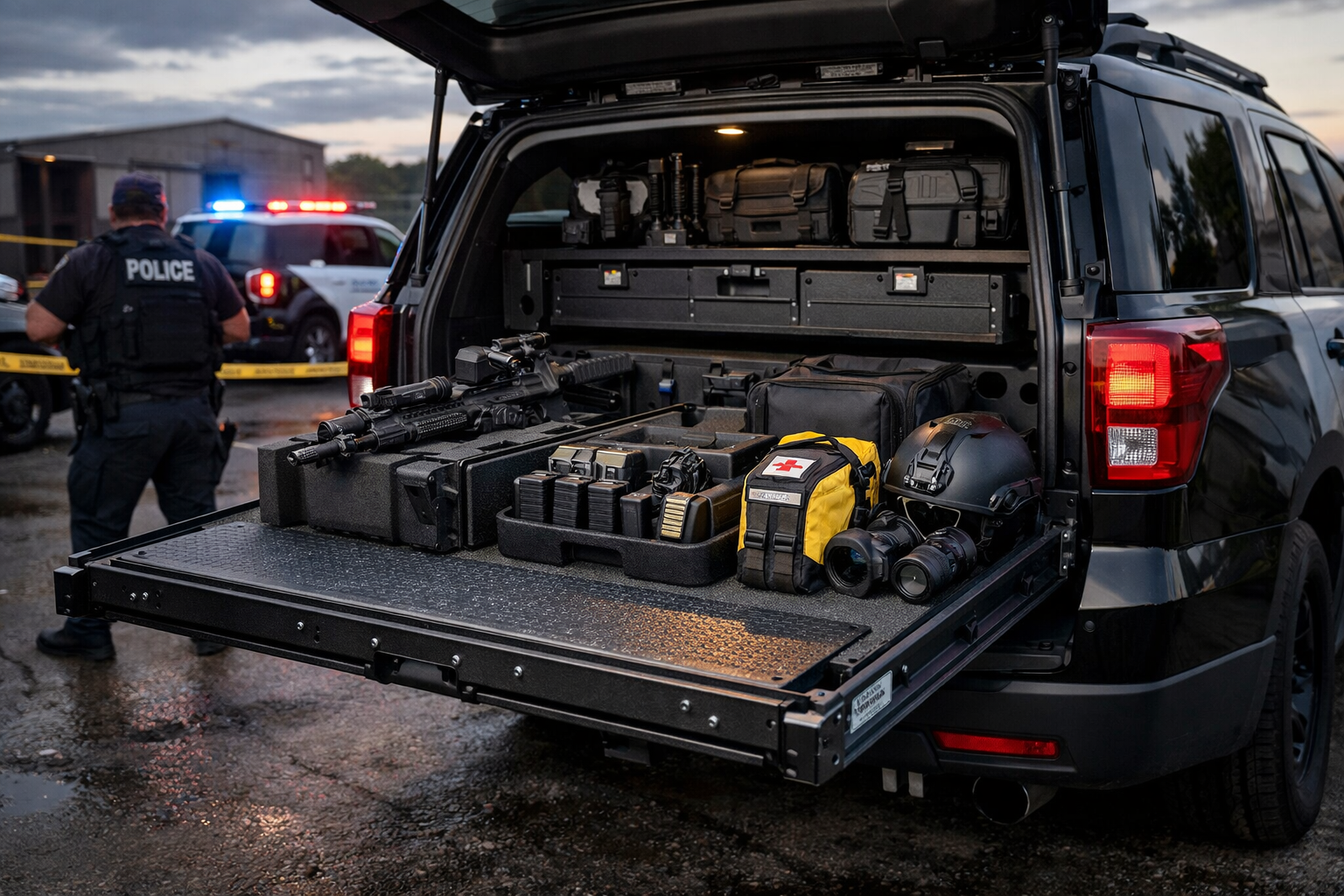
Fleet procurement decisions often get treated as logistics problems. You compare specs, weigh costs, and pick the option that checks the most boxes without blowing the budget. That process works fine for a lot of equipment categories.
But some decisions live closer to the tactical side of the ledger than the financial one — and truck bed slide-out systems are consistently miscategorized. Departments that treat them as a line-item optimization are often the same ones quietly absorbing the downstream costs: slower response, injured officers, and load-outs that constrain the mission instead of supporting it.
This is worth unpacking in some detail, because the case for getting this right goes deeper than most fleet conversations acknowledge.
The Vehicle Is Part of the Mission
Before getting into slide-outs specifically, it's worth establishing the frame. A law enforcement vehicle isn't just transportation. It's a mobile platform — a staging area, a storage system, and in some situations, a piece of cover. What's in it, how it's organized, and how quickly an officer can access it all have direct bearing on how calls unfold.
This is especially true as the scope of what officers are expected to carry has expanded. Departments have added less-lethal options, expanded medical kits, specialized surveillance and documentation gear, crisis intervention tools, and unit-specific equipment for K-9, traffic, SWAT, and crime scene operations. The vehicle that was upfitted five years ago may not be configured for what officers are actually carrying today.
Most of the conversation around vehicle upfitting focuses on lighting, communications, and weapons storage. Cargo access systems — slide-outs, trays, platform extensions — tend to get treated as secondary. That ordering doesn't reflect how much they actually affect daily operations.
Gear Access Is a Readiness Problem, Not a Storage Problem
Here's a distinction that gets lost in most fleet conversations: access and storage are not the same thing.
A vehicle can have ample storage volume and still fail officers on access. If equipment is buried behind other gear, pushed toward the front of a bed, or only reachable by climbing into a cargo area, the storage capacity is partially theoretical. Officers adapt to bad access conditions — they develop workarounds, they re-pack on the fly, they keep the gear they use most near the door and accept that everything else requires effort to reach. These adaptations become invisible because they're normalized, but they represent real operational friction.
Standard cargo configurations create a structural access problem that doesn't get solved by adding more storage. A significant portion of any truck bed or cargo van has to be left as a work area — space for the officer to stand or maneuver while retrieving equipment. That dead zone can consume a third or more of the total cargo footprint.
A slide-out eliminates that dead zone entirely. When the platform extends out to the officer, there's no longer a reason to reserve interior space for physical access. Every inch of the bed becomes usable. Equipment that was previously inaccessible without climbing in can now be reached from the ground, in a controlled stance, in seconds.
For units where the load-out is substantial and mission-critical — bomb squad, crime scene investigation, K-9, SWAT — this isn't a convenience upgrade. It's a fundamental change in what the vehicle can support.
Layout Is a Tactical Variable
Where gear lives inside a vehicle is an operational question, not an organizational one. But it rarely gets treated that way.
Most cargo configurations default to convenience during the upfitting process: frequently used items near the door, larger items in the back, everything else wherever it fits. That logic is intuitive but it's not tactical. It doesn't account for deployment sequence, for how a scene typically unfolds, or for the order in which an officer is likely to need specific equipment under pressure.
When you add a slide-out system, you create the conditions to think about layout more intentionally. The entire platform is accessible at once, so the question becomes: given how this unit actually operates, what's the ideal spatial relationship between every piece of equipment?
High-priority items — the things an officer reaches for first, or under the most stress — belong in positions that require the least physical effort to access. Medical kits, breaching tools, and less-lethal equipment may all need to be in different positions for different unit types. That kind of layout specificity is only possible when the full cargo platform is visible and reachable simultaneously.
The practical result is load-out consistency. Officers who work the same vehicle develop muscle memory around a layout that doesn't change. Under pressure, the reach is practiced, not improvised. That matters considerably in situations where cognitive load is already high and motor automaticity is an asset.
The inverse is equally worth naming: a disorganized or difficult-to-access cargo configuration is a friction point at exactly the moment friction is most costly. Every second spent locating equipment is a second not spent managing a scene. That's not an abstraction — it's a real-time cost with real-time consequences.
The Injury Problem Is Structural, Not Behavioral
Back injuries, muscle strains, and soft tissue damage are persistent problems in law enforcement. The conversation around them tends to focus on use-of-force incidents, foot pursuits, and defensive tactics training. Vehicle access is rarely part of the injury prevention discussion, even though it probably should be.
Reaching into a truck bed is one of the most repetitive physical tasks in a patrol officer's day. It doesn't look dangerous. It doesn't feel dangerous. But leaning deep into a cargo area, twisting to reach equipment stored at angles, climbing in and out of vans on consecutive calls across a twelve-hour shift — these are cumulative injury vectors. The damage they do is gradual, which is exactly why it doesn't register as an equipment problem until it shows up as a personnel problem.
The epidemiology of musculoskeletal injury in physically demanding occupations is well established: it's not the dramatic incidents that account for the most cumulative damage, it's the low-grade repetitive strain that accumulates over months and years. Law enforcement has acknowledged this in areas like vest weight and duty belt design. Vehicle access is the same category of problem.
A slide-out addresses this by fundamentally changing the physical dynamic of gear retrieval. Instead of the officer going to the equipment, the equipment comes to the officer. That's not a minor ergonomic refinement — it's a structural change in the physical demand placed on officers every time they access the vehicle.
But there's an important caveat that fleet managers need to understand before purchasing: not all slide-out systems deliver on this promise equally. Many systems are marketed as full-extension or "100%" slide-outs, but the measurement is misleading. When fully deployed, these platforms often still have 8 to 10 inches of the platform remaining inside the bed. That sounds minor until you consider that an officer trying to reach equipment stored toward the rear of the platform is still leaning into the vehicle — just slightly less than before.
A partial solution to a repetitive strain problem is still a partial solution. The injury risk doesn't disappear; it attenuates. If the goal is genuinely reducing musculoskeletal injury exposure, the specification worth holding vendors to is full platform clearance past the tailgate — ideally beyond the taillights — so that officers have complete, unobstructed access to the entire load-out from a standing position outside the vehicle.
That's when the ergonomic benefit becomes structurally real rather than marginal.
The Workers' Compensation Calculation Most Fleet Managers Don't Run
The financial case for quality slide-out systems is more direct than it usually gets credit for.
Fleet procurement conversations tend to compare unit costs: what does a quality slide-out cost versus a budget option, or versus no system at all? That comparison is incomplete because it only counts the expense, not the cost avoidance.
A single musculoskeletal injury — one back strain serious enough to take an officer off the line — carries costs that extend well beyond the immediate medical claim. There's the Workers' Compensation claim itself, which for a back injury can run well into five figures. There's the administrative burden of managing a modified duty assignment or extended leave. There's the roster gap that either goes unfilled, generating overtime for other officers, or gets covered by a temporary hire with associated onboarding costs. And there's the longer-term question of whether the officer returns to full duty capacity.
Departments that have made deliberate investments in ergonomic vehicle access systems have documented meaningful reductions in job-site injuries. The reduction percentage varies by department and use case, but the directional relationship is consistent: better access systems correlate with fewer repetitive strain incidents.
When you run that math against the cost differential between a quality slide-out and a cheaper alternative, the procurement calculus often inverts. The budget option that saves money at purchase may be the more expensive choice over a three-to-five year fleet cycle.
This is the kind of analysis that rarely makes it into the initial procurement conversation but tends to be very persuasive when it does.
Secure Storage and Liability Exposure
One dimension of slide-out systems that deserves more attention in LE fleet discussions is secure storage integration.
As officers carry more — and as some of what they carry becomes more specialized and sensitive — the question of what happens to that equipment when it's in the vehicle becomes more significant. Weapons, less-lethal munitions, controlled substance test kits, and specialized tactical equipment all carry theft and liability exposure if vehicle storage isn't adequately secured.
A slide-out system designed for law enforcement can be configured with integrated locking storage: weapon drawers with dedicated locking mechanisms, day boxes that meet ATF regulatory requirements, and purpose-built containers for specialized unit equipment. The slide-out becomes not just an access system but a secure evidence and equipment management platform.
This matters for liability reasons, but it also matters for custody chain integrity — particularly for evidence and investigative equipment. Knowing exactly where something is and that access to it is controlled and logged is operationally valuable independent of the security benefit.
What the Procurement Conversation Should Actually Look Like
Most fleet procurement conversations about slide-outs start with: how much does it cost, and can we afford it?
The more useful frame starts with the operational question: what does this unit need to be able to do, and does our current vehicle configuration support that?
From that starting point, the conversation about slide-outs tends to look different. You're not evaluating a feature — you're evaluating whether the vehicle, as currently configured, is actually fit for the mission it's being deployed on. For a lot of units, the honest answer to that question is that it isn't.
The specific questions worth working through before any procurement decision:
On access: Does the current configuration give officers fast, ground-level access to everything in the vehicle? If officers are regularly climbing in, leaning deep, or leaving gear behind because retrieval is too cumbersome, the access problem is real and it's costing time on calls.
On layout: Is the storage layout designed around how this unit actually operates, or around how the upfitter defaulted to organizing the space? For specialized units especially, a generic layout is often a poor fit for unit-specific deployment sequences.
On extension: If evaluating a slide-out system, does it fully clear the bed when deployed? Marketing language around "full extension" or "100% slide-out" is inconsistent across manufacturers. The relevant specification is where the rear edge of the platform sits relative to the tailgate when fully extended. Full clearance past the tailgate is the meaningful threshold.
On integration: Does the system support the secure storage configurations the unit requires? Not all slide-out systems are designed with LE-specific secure storage integration in mind.
On total cost: What's the realistic cost comparison over a fleet cycle, including injury-related costs, not just unit purchase price?
The Bottom Line
Slide-out systems occupy an unusual position in fleet procurement: they're often treated as optional upgrades but function more like operational infrastructure. The departments that treat them as the latter tend to run tighter, safer, more effective field operations — and they tend to find, when they do the full financial accounting, that the investment looks considerably better than the initial sticker price suggested.
The officers using these vehicles are making decisions under pressure, in dynamic conditions, with equipment they need to access reliably and fast. The vehicle should be optimized to support that. A quality slide-out system, properly specified and configured, is one of the more direct ways to make that happen.
Frequently Asked Questions:
What exactly is a truck bed slide-out, and how is it different from standard cargo shelving?
Standard cargo shelving is fixed inside the vehicle. You access it by reaching in, leaning in, or climbing in. A slide-out is a platform or tray mounted on a track system that extends outward from the vehicle — past the tailgate — so the entire cargo surface comes to the officer rather than the officer going to the cargo. The functional difference is significant: full ground-level access to everything on the platform, without leaning, reaching, or entering the vehicle.
Are slide-out systems compatible with all law enforcement vehicle types?
Most quality slide-out systems are engineered for pickup trucks, full-size SUVs, and cargo vans — the primary platforms used in law enforcement fleet upfitting. Compatibility depends on bed dimensions, vehicle weight ratings, and how the vehicle is already configured. Custom-built systems can typically be adapted to fit a specific vehicle's footprint, but it's worth verifying load ratings against your actual cargo weight before specifying a system.
What does a slide-out system actually cost, and how do departments typically fund them?
Unit costs vary considerably depending on system size, load capacity, locking storage integration, and whether the system is off-the-shelf or custom-configured. Entry-level systems may start in the low hundreds; purpose-built law enforcement systems with integrated secure storage can run several thousand dollars per vehicle. Departments typically fund slide-out upfitting through fleet modernization budgets, equipment grants, or as part of vehicle procurement packages. Some departments have successfully made the case for slide-out investment through Workers' Compensation data, framing the spend as injury prevention infrastructure.
How much weight can a law enforcement slide-out system support?
This depends heavily on the system and manufacturer. General-purpose commercial slide-outs may be rated for a few hundred pounds. Systems purpose-built for law enforcement and heavy-duty field use are commonly rated from 1,000 to 3,000 pounds, which accommodates full tactical load-outs including weapons storage, specialized containers, and large unit-specific equipment. Always verify the dynamic load rating — meaning the weight rating while the platform is extended — not just the static rating.
What's the difference between a "100% slide-out" and a fully extending system? Isn't that the same thing?
No, and this distinction matters. "100% slide-out" is a marketing term that doesn't have a standardized definition across manufacturers. In practice, many systems described this way still leave 8 to 10 inches of the platform inside the bed when fully extended. Officers still have to lean in to reach equipment stored at the rear of the platform. A genuinely full-clearance system extends the entire platform past the tailgate — ideally past the taillights — so that officers have unobstructed access from a standing position outside the vehicle. When evaluating systems, ask for the specific measurement of how much platform remains inside the bed at full extension, not just the marketing descriptor.
How long does installation take, and how much downtime does it create for a fleet vehicle?
For most systems, installation is measured in hours rather than days. A straightforward installation on a pickup truck or SUV can typically be completed in a half-day to full-day window, depending on system complexity and whether additional secure storage components are being integrated. Custom configurations with built-in locking drawers, day boxes, or specialized mounting systems may take longer. For fleet managers concerned about vehicle downtime, staggering installations or scheduling during lower-demand periods is the common approach.
Can slide-out systems be transferred when a vehicle is cycled out of the fleet?
In many cases, yes. This is one of the underappreciated financial arguments for investing in a quality system. A well-built slide-out that's properly installed can often be uninstalled and remounted in a replacement vehicle, extending the usable life of the system beyond a single vehicle's service life. The transferability depends on whether the new vehicle has compatible bed dimensions and mounting points. It's worth asking manufacturers about this explicitly during the procurement process, particularly for high-cost custom configurations.
What secure storage options can be integrated into a slide-out system?
Law enforcement-specific slide-out systems can be configured with a range of integrated secure storage, including locking weapon drawers, ATF-regulated day boxes for controlled items, evidence storage compartments, and purpose-built containers for specialized unit equipment. Some systems support electronic locking mechanisms that allow for access logging, which can be relevant for chain-of-custody documentation. The right configuration depends on what the unit is carrying and what the department's security and liability requirements are.
How do slide-outs reduce officer injury risk, and is there data to support that?
The injury reduction mechanism is primarily ergonomic. Reaching into a truck bed — leaning, twisting, extending the spine under load — is a repetitive strain pattern that accumulates over a career. A slide-out eliminates most of that physical demand by bringing the cargo to the officer at a neutral, standing position. Departments that have implemented full-clearance slide-out systems have reported meaningful reductions in musculoskeletal injury claims, with some documenting drops in job-site injuries approaching 50% following the transition. The data on ergonomic intervention and repetitive strain injury in physically demanding occupations is well established in occupational health literature, and vehicle access is consistent with that broader pattern.
What should fleet managers ask vendors before purchasing?
Beyond price and lead time, the questions that matter most:
What is the exact platform measurement remaining inside the bed at full extension?
What is the dynamic load rating at full extension?
What LE-specific secure storage configurations are available?
Is the system transferable to a new vehicle if this one is cycled?
What is the warranty, and what does it cover specifically?
Are there law enforcement agencies currently using this system that we can contact as references?
That last one is worth taking seriously. A vendor confident in their product for LE applications should have no hesitation connecting you with fleet managers who can speak to real-world performance.
Is a slide-out system worth it for patrol vehicles, or mainly for specialized units?
The ROI case is strongest for specialized units — SWAT, K-9, crime scene, traffic — where load-outs are heaviest and access speed is most operationally critical. But the injury prevention argument applies broadly across patrol, and departments that have standardized slide-outs across their fleet rather than limiting them to specialized vehicles report consistent satisfaction with the decision. For standard patrol trucks and SUVs, a simpler, lower-capacity system may be appropriate. The unit type should drive the specification, not a blanket policy in either direction.