What Good Debriefs Actually Look Like: The Gap Between How Departments Process Critical Incidents and What the Science Recommends
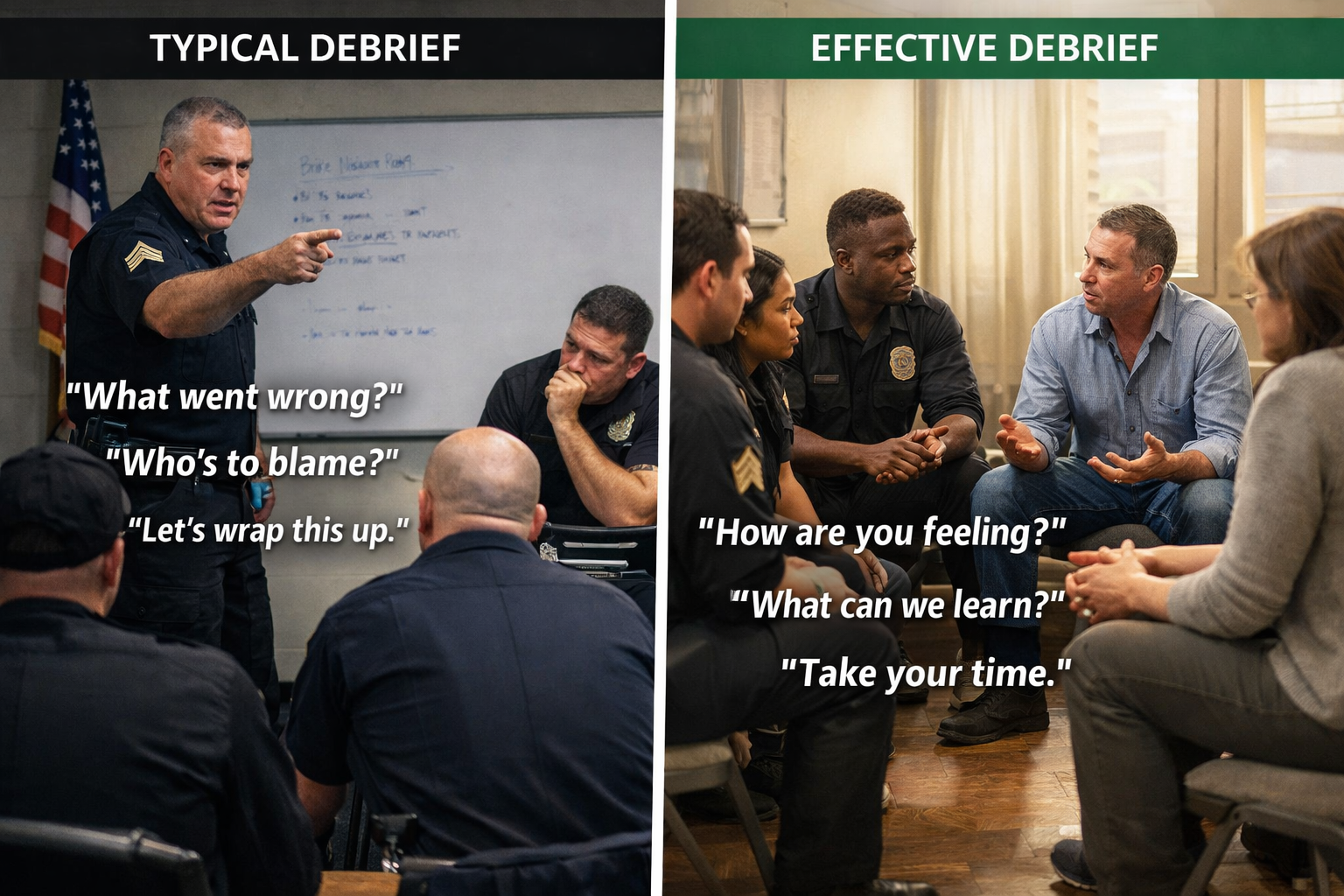
The debrief happens because something went wrong, or because something went right in a way that could have gone wrong, or because the incident was significant enough that someone decided the people involved should gather in a room and talk about it. In most departments, what happens in that room is shaped more by tradition, liability concern, and the personal style of whoever is running it than by any systematic engagement with what the research says actually helps. The gap between the debrief as it is commonly practiced in law enforcement and the debrief as the science recommends it is not a minor procedural detail. It is the difference between a process that supports recovery, extracts organizational learning, and builds team resilience — and one that, at its worst, actively increases the risk of post-traumatic stress symptoms in the people it is supposed to help. This article breaks down what the research shows, where common practice goes wrong, and what a genuinely effective critical incident debrief looks like.
What Departments Are Actually Doing
The most widely used post-incident process in law enforcement is some variant of Critical Incident Stress Debriefing — CISD — a structured group intervention developed by Jeffrey Mitchell in the 1980s that became the dominant model for emergency services psychological support through the 1990s and into the early 2000s. The Mitchell model follows a structured sequence: fact phase, thought phase, reaction phase, symptom phase, teaching phase, and re-entry phase, typically facilitated by a trained peer support member or mental health professional within 24 to 72 hours of the incident.
Many departments run modified versions of this model — some more clinical, some more operational, some that have drifted so far from any structured format that they amount to an informal group conversation with a supervisor present. A separate category of debrief — the operational or tactical debrief — focuses on what happened and what could be done differently from a procedural standpoint, largely without psychological content. The two types are frequently conflated, run together in ways that create problems for both, or run independently in ways that leave significant gaps in what gets addressed.
What is notably rare is a debrief process that has been designed with direct reference to what the research on critical incident response, trauma processing, and organizational learning actually recommends. Most departments are running inherited models with minimal evidence base, implemented by people who received minimal training in how to run them, without any systematic evaluation of whether they are producing the outcomes they are supposed to produce.
What the Research Actually Shows
The CISD Problem
The research on Critical Incident Stress Debriefing is one of the more uncomfortable bodies of evidence in emergency services psychology — uncomfortable because the model is so widely used, so institutionally embedded, and so sincerely believed in by the people who deliver it. The findings, accumulated across multiple randomized controlled trials and systematic reviews over the past two decades, are not ambiguous.
Single-session psychological debriefing — the core format of CISD — does not reliably prevent post-traumatic stress disorder. Several high-quality studies found that CISD had no effect on PTSD rates compared to no intervention. More concerning, a subset of studies found that mandatory or pressured participation in psychological debriefing was associated with worse outcomes than no debriefing at all. The proposed mechanism is that requiring individuals to verbally reconstruct and emotionally re-engage with a traumatic incident within 24 to 72 hours — before natural psychological processing has begun — may interrupt or interfere with the brain's endogenous stress response resolution process rather than supporting it.
The National Institute for Health and Care Excellence in the UK removed single-session debriefing from its recommended interventions for trauma following this evidence. The International Society for Traumatic Stress Studies does not recommend it as a standalone intervention. The American Psychological Association does not list it among its empirically supported treatments for trauma.
None of this means that gathering people after a critical incident is harmful or pointless. It means that the specific format most commonly used — mandatory, single-session, emotionally focused group reconstruction within 72 hours — is not supported by evidence as a psychological intervention and may cause harm in a subset of participants. The research separates the instinct, which is sound, from the implementation, which is frequently not.
What Does Help
The evidence on what actually supports recovery after critical incident exposure points in several consistent directions that differ meaningfully from the CISD model.
Psychological First Aid rather than psychological debriefing is the intervention with the strongest evidence base for the immediate post-incident period. Psychological First Aid — developed collaboratively by the National Child Traumatic Stress Network and the National Center for PTSD — focuses on practical support, safety, calm, connection, self-efficacy, and information rather than emotional reconstruction of the incident. It is not therapy. It is a structured approach to meeting the practical and social needs that predict recovery trajectory in the hours and days following trauma exposure. The research supports it as the appropriate immediate intervention; psychological processing belongs later, when the nervous system has had time to begin its own resolution process.
Voluntary rather than mandatory participation consistently shows better outcomes than compelled debriefing. The evidence that mandatory debriefing can worsen outcomes is strong enough that most professional bodies now recommend that any psychologically focused post-incident intervention be voluntary. This is a significant departure from how most law enforcement debriefs are structured, and it creates real administrative challenges for departments accustomed to mandatory post-incident processes. Those challenges are worth navigating.
Individual follow-up is more effective than group processing alone. The research on resilience and recovery after occupational trauma consistently identifies access to individual mental health support — not necessarily formal therapy, but at minimum a structured check-in with someone trained to assess stress response and provide referrals — as more reliably beneficial than group debriefing formats. Group processes have value for organizational learning and peer connection. They are not a substitute for individual support, and departments that rely on group debriefs as their primary or only post-incident mental health response are under-investing in the intervention that has the stronger evidence base.
Timing matters more than most departments appreciate. The 24 to 72 hour window that the CISD model targets is, according to the research, precisely the wrong time for emotionally focused processing. The acute stress response is still active. Natural recovery processes are underway and may be interrupted by forced reconstruction. The evidence supports practical support and connection in the immediate aftermath, followed by psychologically focused support at two to four weeks — after the acute phase has resolved and it becomes possible to identify who is recovering naturally and who needs additional intervention.
The Operational and Psychological Debrief Conflation Problem
One of the most consistent structural problems in law enforcement debrief practice is the conflation of two fundamentally different processes that serve different purposes and require different formats.
The Operational Debrief
An operational debrief is an after-action review. Its purpose is organizational learning — what happened, in what sequence, what decisions were made and why, what worked, what didn't, and what should be done differently next time. It is investigative and forward-looking. It requires honest, specific, critical engagement with tactical and procedural decisions. It benefits from being conducted relatively soon after the incident while details are fresh. It is appropriately mandatory — organizations have a legitimate interest in learning from critical incidents and adjusting practice accordingly.
The operational debrief is not the place for psychological processing. When supervisors use operational debriefs to simultaneously address the emotional impact of an incident — because it feels efficient, because they are uncomfortable with the psychological content, or because there is no separate process for it — they create a format in which officers feel unable to honestly discuss tactical errors for fear of emotional exposure, and unable to honestly discuss psychological impact in a context that is simultaneously evaluative of their professional performance.
The Psychological Debrief
A psychological debrief — or more accurately, a post-incident psychological support process — is not an after-action review. Its purpose is to support the wellbeing of the people involved, normalize stress responses, identify who may need additional support, and create connection among people who shared a significant experience. It is not investigative. Nothing said in it should have professional consequences. It should not be facilitated by someone in the chain of command of the participants. It should be voluntary. And it should not attempt to compress all of these goals into a single session within 72 hours of the incident.
Departments that run one meeting that attempts to be both of these things are serving neither purpose effectively. The operational learning is compromised by the psychological content. The psychological support is compromised by the evaluative context. The result is a process that officers learn to perform rather than engage with — saying the right things for the operational record and the right things for the wellness check, without doing either one honestly.
Who Should Be Running Debriefs
The question of facilitation is one that most departments answer by default — whoever is available, whoever holds the peer support designation, whoever the supervisor assigns — rather than by design. The research has clear implications for what effective facilitation requires.
The Chain of Command Problem
Debriefs facilitated by someone in the direct chain of command of the participants produce consistently worse psychological outcomes and less honest operational engagement than those facilitated by someone outside it. The reason is straightforward: officers do not process difficult experiences honestly in front of people who evaluate their performance and make decisions about their careers. The organizational hierarchy that is appropriate and necessary for operational command is antithetical to the psychological safety that honest debrief participation requires.
This is not a criticism of supervisors. It is a structural observation about the incompatibility of evaluative authority and psychological safety in the same room at the same time. Departments that want effective debriefs need to build facilitation capacity that is organizationally separate from the chain of command — trained peer support members, mental health professionals, or external facilitators depending on the nature and severity of the incident.
Peer Support Versus Mental Health Professional
The research supports a differentiated model rather than an either-or choice. Peer support — officers who have been trained in psychological first aid, stress response normalization, and referral pathways — is appropriate for the immediate post-incident period and for lower-severity incidents. Mental health professionals are appropriate for higher-severity incidents, for follow-up with individuals showing significant stress response, and for any situation where clinical assessment or therapeutic intervention may be needed. Departments that rely exclusively on peer support are under-resourced for serious incidents. Departments that rely exclusively on mental health professionals miss the credibility and access advantages that peer support provides in a culture that is often skeptical of clinical intervention.
What a Well-Designed Debrief Process Actually Looks Like
Drawing from the research on psychological first aid, organizational learning, trauma-informed practice, and peer support effectiveness, a well-designed post-incident process has several components that most law enforcement debriefs currently lack.
Separation of Operational and Psychological Processes
These are two different meetings, run at different times, by different people, with different purposes, different ground rules, and different outcomes. The operational debrief happens relatively soon after the incident for organizational learning. The psychological support process happens on a timeline that respects the neurobiology of stress response — not in the first 24 hours, not as a mandatory single session, but as an ongoing process that begins with practical support and evolves into more structured psychological engagement as the acute phase resolves.
A Clear Framework for the Psychological Support Component
The research supports a tiered approach that matches the intensity of support to the severity of the incident and the individual response. Basic psychological first aid — practical support, normalization of stress responses, connection to peers and resources — for everyone involved. A structured check-in at two to four weeks for all participants, designed to identify who is recovering naturally and who may need additional support. Access to individual mental health services, without administrative consequences for accessing them, for anyone who needs it. This is not a single meeting. It is a process with multiple touchpoints on a timeline that the research supports.
Voluntary Participation in the Psychological Component
Mandatory operational debriefs are appropriate. Mandatory psychological processing is not supported by evidence and is contraindicated in a subset of participants. Building a culture in which voluntary participation in psychological support is normalized — in which accessing support is visibly modeled by leadership as a strength rather than quietly practiced as a weakness — is the organizational work that makes the voluntary framework actually function.
Facilitation Outside the Chain of Command
The psychological support component should be facilitated by someone who does not evaluate the participants professionally. Peer support members from outside the immediate unit, mental health professionals, or external facilitators are all preferable to direct supervisors for this purpose. The operational debrief can and should involve supervisory leadership. The psychological component should not.
Documented Follow-Up
One of the most consistent failures in current debrief practice is the absence of structured follow-up. A debrief happens, the meeting ends, and the assumption is that the process is complete. The research on trauma recovery timelines is clear that the two-to-four week window is when many stress responses either resolve naturally or begin to consolidate into more persistent symptoms — and that this is exactly when a structured check-in is most valuable. Departments that build follow-up into their post-incident process rather than treating the initial debrief as the end of the response are providing the support that the evidence actually recommends.
The Cultural Barrier
All of the above runs directly into the most consistent obstacle in law enforcement mental health support: a culture in which accessing psychological help is experienced as a threat to professional identity, peer respect, and career security. This is not irrational given the environments in which it developed. It is, however, increasingly incompatible with what the evidence shows officers need — and with the legal and liability landscape that departments are navigating as occupational stress claims, PTSD diagnoses, and mental health-related disability retirements continue to increase.
The research on culture change in law enforcement mental health support consistently identifies leadership modeling as the highest-leverage intervention. When senior officers and command staff visibly and specifically normalize help-seeking — not in general policy statements but in specific first-person acknowledgment that the job produces psychological effects that deserve attention — the cultural signal changes in ways that permission structures and peer support programs alone cannot produce.
Changing the debrief is a technical problem with a research solution. Changing the culture that determines whether officers actually engage with what the debrief offers is a leadership problem, and it is the harder one.
The Bottom Line
Departments that run CISD-model mandatory psychological debriefs within 72 hours of critical incidents are not running evidence-based practice. They are running a 40-year-old model that the research has substantially revised, delivered with sincerity but without the design updates that the evidence supports. The officers going through those processes deserve better — not because the intention is wrong but because the implementation is out of date.
Good debriefs are actually two separate processes run on different timelines for different purposes by different people with different formats. They are voluntary on the psychological side and mandatory on the operational side. They involve follow-up rather than treating a single session as a complete response. They are facilitated outside the chain of command. And they exist within a culture that leadership has explicitly worked to make safe enough that voluntary participation actually means something.
That is a more complicated system to build than a single mandatory meeting. It is also the one that the evidence supports. The gap between those two things is not a funding problem or a staffing problem. It is a knowledge problem — and knowledge problems, at least, are solvable.
Threat Ready LE is an independent publication built for law enforcement professionals who want to understand the research behind the job — not just the doctrine. We cover threat recognition, officer wellness, mental health, de-escalation, and the science of crisis response.
Frequently Asked Questions
Is CISD completely discredited or is there still a place for it?
The research has not concluded that gathering people after a critical incident is harmful — it has concluded that the specific format of mandatory, single-session, emotionally focused group reconstruction within 72 hours is not supported as a psychological intervention and may worsen outcomes in a subset of participants. There is still a place for structured group processes after critical incidents. That place is just not where CISD puts it — in the acute stress window, as a mandatory psychological processing exercise, facilitated by whoever is available. The instinct behind CISD is sound. The implementation details are what the evidence has revised. Departments that want to preserve the peer connection and normalization functions that CISD was designed to serve can do so within a framework that the research actually supports — voluntary participation, appropriate timing, separation from the operational review, and facilitation outside the chain of command.
Why do so many departments keep using CISD if the research doesn't support it?
Several reasons that are worth understanding rather than dismissing. CISD became institutionally embedded in emergency services before the contradicting research accumulated — it was adopted widely in the 1990s when the evidence base appeared supportive, and institutional inertia is powerful. The people who deliver it frequently believe genuinely in its value, and anecdotal experience of participants who found it helpful is real even if it doesn't translate to population-level outcome improvements. There is also a liability dimension — departments that have a documented post-incident process feel more protected than those that don't, regardless of whether that process is evidence-based. And changing a deeply embedded practice requires acknowledging that the previous practice may have caused harm, which is organizationally and personally difficult for the people who delivered it with good intentions. None of these reasons justify continuing a practice the evidence has revised, but understanding them is necessary for designing change efforts that actually work.
What is Psychological First Aid and how is it different from a debrief?
Psychological First Aid is a structured approach to supporting people in the immediate aftermath of a traumatic or stressful event that focuses on practical needs rather than psychological processing. It was developed collaboratively by the National Child Traumatic Stress Network and the National Center for PTSD and is built around eight core elements: contact and engagement, safety and comfort, stabilization, information gathering, practical assistance, connection with social supports, information on coping, and linkage to collaborative services. It is explicitly not therapy and not psychological debriefing. It does not ask people to reconstruct or emotionally re-engage with what happened. It focuses on what the person needs right now — practical support, connection, information, and a sense of safety — rather than on processing what happened. The research supports it as the appropriate immediate post-incident intervention precisely because it works with the acute stress response rather than attempting to override it with psychological reconstruction.
How should departments handle officers who don't want to participate in any post-incident support process?
With respect for that position combined with a structure that keeps the door open. The research on mandatory versus voluntary participation is clear enough that compelling psychological participation is not defensible practice. What departments can do is ensure that the decision not to participate is genuinely voluntary rather than driven by fear of stigma or professional consequences, create a follow-up touchpoint at two to four weeks that is low-pressure and practically framed — a check-in rather than a debrief — and make individual support access easy enough that officers who initially decline have a clear and consequence-free pathway to engage later if their experience shifts. The officer who declines immediately after an incident and asks for support three weeks later when sleep disruption and intrusive thoughts have accumulated is exhibiting exactly the recovery trajectory the research predicts. The system should be designed to catch them at that point rather than treating the initial declination as the end of the department's responsibility.
Should officers involved in a critical incident be separated before a debrief?
This is one of the more contested practical questions in post-incident process design, and the answer depends on which type of debrief is being discussed. For the operational debrief — the after-action review focused on what happened — there is a strong argument for separating officers before they discuss the incident with each other, to preserve independent recall and prevent the memory contamination that occurs when people construct a shared narrative before individual accounts are documented. This is standard practice in serious incident investigations and the cognitive science of memory supports it. For the psychological support process — which is not investigative — the separation requirement is less clear, and there is value in peer connection that shared experience provides. Departments that conflate the two processes create a situation where the rules appropriate for one are applied to the other, producing either contaminated operational accounts or psychologically isolated officers depending on which way the conflation runs.
What makes peer support effective versus performative?
The difference is largely structural. Peer support that works involves officers who were selected for interpersonal capability rather than seniority or availability, trained specifically in psychological first aid and stress response recognition rather than just given a designation, given protected time and organizational backing to do the work, and kept organizationally separate from the evaluation and discipline functions of the department. Peer support that is performative involves officers who got the designation because someone had to have it, who received minimal training, who are expected to fulfill the role on top of a full operational schedule without protected time, and who operate in a culture that hasn't actually changed its relationship to help-seeking. The designation without the structure produces peer supporters who are nominally available but functionally inaccessible — officers know they exist but don't trust the access or the confidentiality enough to use them. Building effective peer support is an organizational design problem, not a training problem.
How does the debrief process interact with administrative investigations after a critical incident?
This is one of the most significant structural tensions in law enforcement post-incident response, and it is one that most departments have not resolved adequately. When a critical incident triggers both an administrative or criminal investigation and a psychological support process, officers face a genuine conflict — anything they say in a psychological context may be discoverable, may be used in an administrative proceeding, or may create inconsistencies with statements made in the investigative context. The result is that officers either don't participate honestly in the psychological process, don't participate at all, or say things in a debrief that create problems in a subsequent investigation. The research-supported solution is clear separation — legally protected confidentiality for the psychological support process that is explicitly and credibly distinguished from the investigative process, with different facilitators, different documentation practices, and explicit communication to officers about what is and is not confidential. Departments that haven't built this separation are running a psychological support process that officers rationally don't trust, which means they aren't actually running a psychological support process at all.
What role should command staff play in post-incident debriefs?
Different roles in different processes, which is the answer most departments aren't currently implementing. In the operational debrief, command staff have an appropriate and necessary role — they are accountable for the organizational learning the process is supposed to produce and they have authority to implement the changes it recommends. In the psychological support process, command staff should not be present as participants in a position of authority over the people being supported. The research on psychological safety is unambiguous that evaluative authority and honest emotional processing are incompatible in the same room at the same time. The most valuable thing command staff can do for the psychological support process is stay out of it while publicly and specifically communicating that participation is valued, consequential access to support is not punished, and the department takes the psychological impact of the job seriously enough to invest in a process that actually works.
How long should the post-incident support process continue?
Longer than most departments currently run it, and on a timeline that reflects the neurobiology of trauma recovery rather than administrative convenience. The acute stress phase — the first two to four weeks — is when natural recovery processes are most active and when the appropriate intervention is practical support and connection rather than psychological processing. The two-to-four week window is when a structured check-in is most valuable, because it is when the difference between natural recovery and emerging persistent symptoms first becomes identifiable. Three months is when PTSD diagnostic criteria can first be formally applied, though sub-threshold symptoms that warrant support can present earlier. Officers who are still experiencing significant symptoms at the one-month mark benefit from individual mental health referral. The structure the research supports is not a single debrief plus an open-door policy — it is a tiered process with defined touchpoints at one week, one month, and three months, with clear referral pathways at each stage for officers whose trajectory indicates they need more than the standard process provides.
What should an officer do if their department's debrief process feels unhelpful or harmful?
Use it for what it's actually good for — which in most cases is the peer connection and normalization functions that group process provides — while actively seeking the individual support that the group process isn't designed to replace. The practical reality is that most departments are running debrief processes that the evidence has substantially revised, and individual officers cannot unilaterally redesign their department's post-incident process. What they can do is understand what the process they have is and isn't, use the peer relationships it creates, access individual mental health support through whatever pathway their department provides — EAP, peer referral, or direct access — and not mistake the completion of a debrief for the end of their responsibility to monitor their own psychological state. The research on occupational trauma in law enforcement is clear that cumulative exposure produces effects that individual resilience alone doesn't fully absorb. A debrief that doesn't provide adequate support is a system failure, not a personal one, and officers who recognize it as such are better positioned to seek what they actually need.