Why Police Marriages Fail at Higher Rates — and What the Data Actually Shows
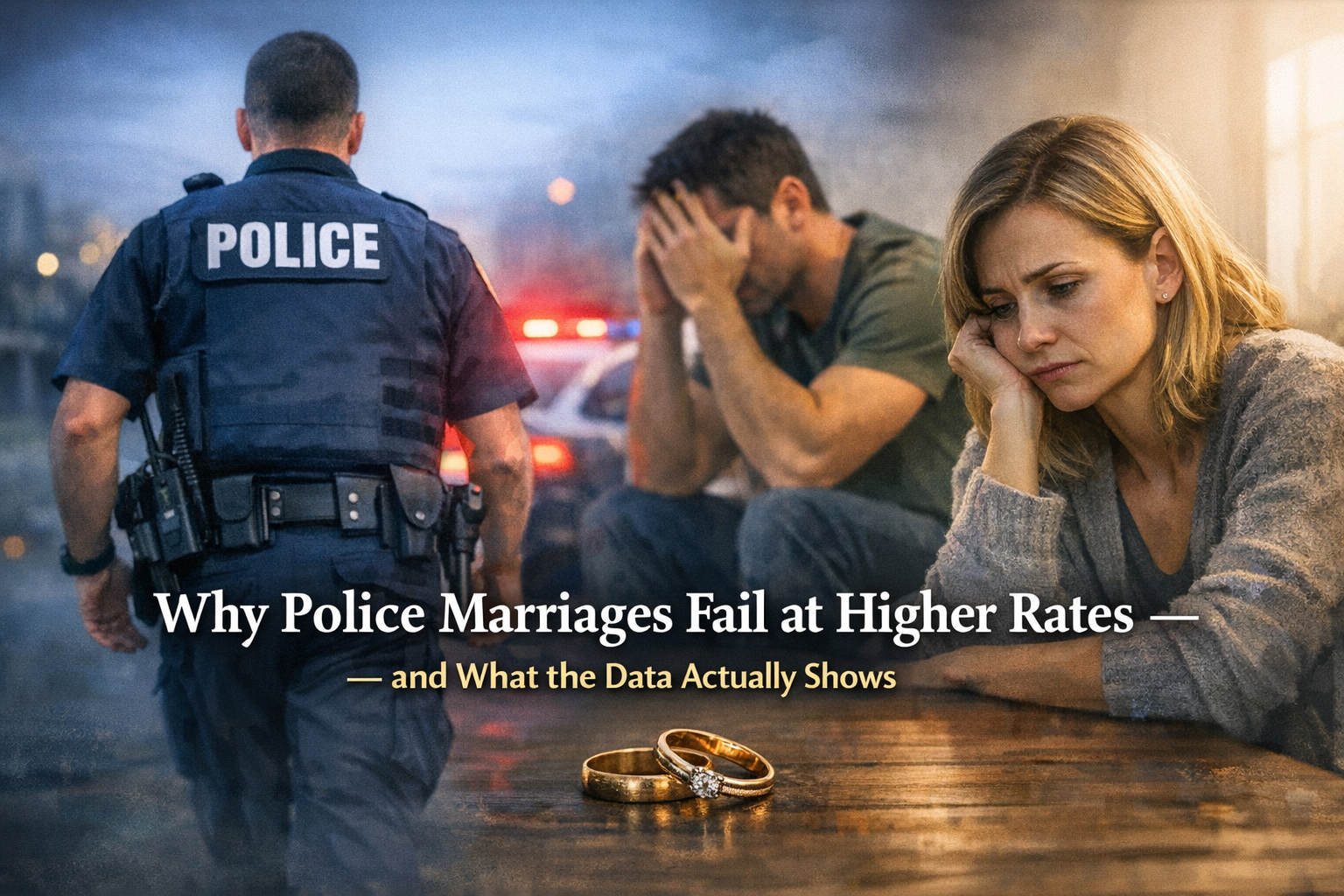
The statistic gets quoted at academy graduations, in wellness trainings, in retirement speeches, and in the kind of dark humor that law enforcement families develop as a coping mechanism. The divorce rate for police officers is astronomical — 70 percent, 75 percent, higher than almost any other profession, a near-certainty if you stay in the job long enough.
Like a lot of things repeated confidently enough that they become professional folklore, the reality is more complicated than the headline.
This article is going to do two things. First, it is going to be honest about what the data actually shows on law enforcement divorce rates — which is messier and more contested than most wellness discussions acknowledge. Second, and more importantly, it is going to examine the specific mechanisms that the research consistently identifies as drivers of relationship failure in law enforcement families — because those mechanisms are real, documented, and worth understanding regardless of what the precise divorce percentage turns out to be.
What the Data Actually Shows
The claim that police officers divorce at twice the national rate — or at 70 percent, or at rates higher than almost any profession — is repeated so frequently and with such confidence that most people inside law enforcement have simply accepted it as established fact.
The research is considerably less settled.
A peer-reviewed analysis published in the Journal of Police and Criminal Psychology examined U.S. Census data and found that the divorce rate for law enforcement personnel was actually lower than that of the general population, even after controlling for demographic and other job-related variables. Springer This finding directly contradicts the conventional wisdom and has never been fully reconciled with the folklore figures.
The FBI Law Enforcement Bulletin has acknowledged the contradiction directly, noting that while some statistics show law enforcement divorce rates as high as 70 percent, many researchers believe there is no empirical data supporting a higher rate — and that some data indicates a lower divorce rate among officers than the general public. FBI
The Bureau of Labor Statistics data on protective service occupations — which include police officers — shows a divorce rate of approximately 30.69 percent, compared to an overall rate of 16.9 percent for all occupations. My blog That is elevated, but it is nowhere near the 70 percent figure that circulates in professional culture.
What explains the gap between the folklore and the research? Several things.
The 70 percent figures that circulate most widely tend to come from specific regional studies, self-selected survey samples, or anecdotal professional testimony rather than from representative national data. A California-specific study found a divorce rate of 61 percent for law enforcement families — a genuinely high figure that may accurately reflect conditions in a specific state with specific cost-of-living pressures and specific departmental cultures, but that cannot be generalized nationally. Sarieh Family Law
A smaller survey-based study found that 53 percent of officer respondents had experienced a divorce or separation, with the majority attributing it to work-related issues, time away from home, and stress. Utah Valley University Again, a self-selected survey sample of officers willing to participate in wellness research is not a representative sample of the profession.
The honest summary of the data is this: law enforcement officers probably do divorce at higher rates than some professions and possibly at higher rates than the general population — but the magnitude of that elevation is significantly more uncertain than the confident 70 percent figure implies. What is not uncertain is the presence of specific, well-documented mechanisms that put law enforcement relationships under extraordinary pressure. Whether those mechanisms produce divorce at twice the national rate or at some other multiple, they are real, they are measurable, and they are worth taking seriously.
The Mechanisms: What Actually Happens to Law Enforcement Marriages
The research on why law enforcement relationships fail is substantially more consistent than the research on how often they fail. Across studies, across methodologies, and across decades of professional literature, the same mechanisms appear repeatedly. Understanding them is more useful than arguing about the precise divorce percentage.
Shift work and schedule disruption
The damage that shift work does to intimate relationships is one of the most consistently documented findings in the occupational health literature — and it is not unique to law enforcement. What is unique to law enforcement is the combination of shift work with the specific nature of the job's psychological demands.
Officers on rotating shifts are structurally prevented from participating in the rhythms that sustain intimate relationships — shared meals, shared evenings, shared weekends, the accumulated small moments of daily life that build connection over time. Their partners manage households, raise children, maintain social relationships, and navigate daily life largely alone — and then find themselves living alongside someone who is physically present but psychologically elsewhere when they are home.
Shift work also disrupts sleep in ways that compound every other stressor. Chronically sleep-deprived people are more irritable, less empathic, less emotionally regulated, and less capable of the sustained attention that intimate relationships require. The sleep disruption of shift work is not an incidental annoyance — it is a chronic impairment of the neurological systems that make sustained intimacy possible.
The emotional unavailability that comes home from the job
Officers are trained — explicitly and implicitly — to suppress emotional response on the job. The ability to function in crisis without being overwhelmed by what you are seeing requires a degree of emotional compartmentalization that is genuinely adaptive in the field. The problem is that the compartmentalization does not reliably turn off when the shift ends.
Partners and children describe the same experience across decades of qualitative research on law enforcement families: the officer who comes home is physically present but emotionally somewhere else. Not hostile, not angry — just not there. The warmth, the presence, the emotional availability that intimate relationships require is inaccessible in a person whose nervous system has spent eight or twelve hours in a mode that requires its suppression.
Over time, this pattern produces a specific kind of relational damage. The partner stops bringing things to the officer — stops sharing the small difficulties and the emotional moments of daily life — because experience has taught them that the response will be either absent or perfunctory. The emotional intimacy of the relationship gradually hollows out. The partners become functional co-inhabitants of a household rather than intimate partners. And often neither person can fully articulate what happened or when it started, because it was not a single event — it was the accumulated weight of thousands of small moments of absence.
Hypervigilance that colonizes home life
The off-duty vigilance problem described elsewhere on this site — the nervous system that cannot fully downregulate in the domestic environment — is not just an inconvenience for the officer. It is an active stressor for everyone who lives with them.
Partners and children of officers consistently describe living inside a low-level tension that they have learned not to name directly. The scanning of rooms when they enter. The positioning at restaurant tables with sightlines to the door. The threat assessments that run silently through interactions with strangers. The sudden alertness when something in the environment changes. None of these behaviors are dramatic. All of them communicate, continuously and without words, that the person they live with is never fully present in the domestic space — that part of them is always somewhere else, monitoring for something.
Children in law enforcement families develop adaptations to this ambient tension that researchers have documented across multiple studies — a learned quietness, a hyper-attunement to the officer parent's mood, a tendency to manage their own behavior in ways designed to avoid triggering the threat-detection system they live inside. These adaptations are themselves a form of damage that the research connects directly to the officer's occupational conditioning rather than to individual parenting failures.
Secondary traumatic stress and its relational consequences
Officers absorb traumatic material in quantities that are genuinely extraordinary by the standards of most occupations. The cumulative exposure to violence, death, suffering, and human cruelty — across a career that may span three decades — produces a form of psychological burden that the clinical literature calls secondary traumatic stress, and that produces a specific constellation of relational consequences.
The numbing that comes with cumulative trauma exposure — the gradual desensitization that allows the officer to function in the field — does not stay contained to the professional domain. Partners describe the same phenomenon from the outside: the person they married was capable of a certain quality of feeling and responsiveness that has gradually receded over the years of the career. Events that would have moved them earlier in their life produce less visible response. Tenderness becomes more effortful. The range of emotional expression narrows.
This is not a character change. It is a neurological adaptation. But it feels, from the inside of the relationship, like a withdrawal of the person. And over time, partners who have watched the person they love recede behind the job's emotional armor often stop trying to reach them — not because they have stopped caring, but because the effort of reaching someone who consistently cannot be reached becomes its own kind of exhaustion.
The culture of secrecy and the partner's exclusion
Law enforcement professional culture has a strong norm around not bringing the job home — a norm that is simultaneously protective and destructive. Protective because some degree of boundary between work and home is genuinely necessary for officers and their families. Destructive because the norm is often applied so absolutely that partners are structurally excluded from any real understanding of what the officer is carrying.
Partners in law enforcement relationships frequently describe feeling like they are living with someone who has a second life they are not allowed to enter. They know something happened on shift — the body language, the particular quality of silence, the way the officer is with the children that evening all tell them something happened. What they cannot know is what it was, what it meant, or how serious it is. They are left to manage their own anxiety about their partner and their partner's wellbeing without any information to work with.
The secrecy norm also prevents the kind of disclosure that allows intimate partners to support each other through difficult experiences. The officer who cannot tell their partner what they are carrying cannot receive their partner's support. The support that sustains long-term intimate relationships — the being known, the being held through difficulty — is not available in a relationship where one partner's professional life is categorically off-limits.
The personality adaptation problem
The qualities that make a good officer — precision, decisiveness, command presence, the suppression of emotion in favor of efficiency, a tendency toward dominance in ambiguous situations — often make a genuinely difficult domestic partner. Lexipol This is not a critique of officers as people. It is a recognition that the job selects for and cultivates traits that are adaptive in the field and maladaptive at home.
The officer who is trained to take command of volatile situations does not always have a reliable internal switch that turns off that orientation when they walk through their own front door. The officer who has spent a shift making decisions that cannot be questioned brings that decision-making style home to negotiations about dinner plans and parenting choices. The officer whose professional survival has depended on reading situations quickly and acting decisively is not well-positioned for the ambiguity, the patience, and the collaborative processing that domestic life requires.
These adaptations are not fixed. They can be identified, named, and worked with — in individual therapy, in couples therapy, in peer conversations that normalize the gap between professional and domestic self. But they cannot be worked with until they are named. And they are rarely named, because the same professional culture that produces them treats any questioning of them as a threat to professional identity.
What Partners Carry
Any honest account of law enforcement marriage failure has to include what the partner carries — because the research on law enforcement spouse wellness is thin, the public conversation is thinner, and the assumption that the officer is the only one doing something difficult has contributed significantly to the relational damage these marriages accumulate.
Partners of law enforcement officers absorb a specific occupational burden that has no name in the professional wellness literature and very little recognition in departmental support structures. They manage the household alone for most of the hours of most of their days. They raise children largely without the other parent's sustained presence. They live inside the ambient hypervigilance without having any of the professional context that might make it comprehensible. They watch the person they married gradually change in ways they cannot name and were not warned about. They worry, every shift, about whether that person is coming home.
That worry is not irrational. Officers are two to four times more likely to suffer from PTSD compared to the general population My blog, and the relationship between untreated PTSD and relationship failure is well-documented. The partner who is managing that worry, that aloneness, and that gradual relational erosion — while also being told, explicitly or implicitly, that the job comes first and that what happens on the job is not their business — is carrying something significant.
The marriages that survive in law enforcement are not the ones where the partner simply endures all of this without complaint. They are the ones where the couple has found ways — imperfect, effortful, ongoing — to bridge the gap between the officer's professional world and the domestic world they share. To find language for what the officer is carrying without violating the norms that protect the officer. To maintain a connection that the job continuously works to erode.
That work is possible. It is not easy. And it is not the officer's work alone.
What Helps
The research on what actually protects law enforcement marriages is less developed than the research on what damages them — but it is not absent.
Peer support programs that include family components consistently show better outcomes than those focused exclusively on the officer. Couples therapy with therapists who have law enforcement-specific training — who understand the professional culture, the secondary traumatic stress, and the specific dynamics of law enforcement family life — produces better outcomes than general couples therapy. Departments that build family support infrastructure into their wellness programs — family orientation programs, family days, formal acknowledgment that the partner is also carrying something — produce measurably better family outcomes than departments that treat family wellness as entirely outside their purview.
And the individual practices that matter most are the ones that seem smallest: the officer who can say, without disclosing operational detail, "today was hard" — who can let their partner know that something happened without requiring them to manage the absence of information. The partner who can receive that without needing more than they are given. The couple that has built, over time, a shared language for what the job costs that does not require one person to carry everything and the other person to receive nothing.
That language does not develop automatically. It has to be built deliberately, in a culture that does not provide a template for it.
This article is one small attempt at providing that template.
ThreatReady LE publishes weekly intelligence on threat recognition and trauma-informed practice for law enforcement. Subscribe free at threatreadyle.com.
Frequently Asked Questions
Is the 70 percent divorce rate figure actually true?
The honest answer is that it is probably not accurate as a national figure, and the research does not support it as a reliable statistic. At least one peer-reviewed analysis found that law enforcement divorce rates were actually lower than the general population when controlling for demographic variables. Springer Bureau of Labor Statistics data on protective service occupations shows a divorce rate of approximately 30.69 percent — elevated compared to the overall occupational average of 16.9 percent, but nowhere near 70 percent. My blog The higher figures tend to come from regional studies, self-selected survey samples, or anecdotal professional sources that cannot be generalized nationally. What can be said with confidence is that law enforcement relationships face specific, well-documented pressures that elevate relational strain — and that the precise percentage matters less than understanding and addressing those pressures.
Why does the 70 percent figure persist if it isn't well-supported?
Because it feels true to the people inside the profession, and felt truth is more durable than contested research findings. Officers look around at their colleagues and they see a pattern — the serial marriages, the divorces, the partners who left after a certain number of years. That pattern is real even if the precise percentage attached to it is not. The figure also serves a function in professional culture — it is part of the shared narrative of sacrifice that law enforcement professional identity is built around, and narratives that reinforce professional identity tend to be resistant to correction by data. None of that makes the 70 percent figure accurate. It makes it understandable that it persists.
My partner says I'm emotionally unavailable but I feel like I'm doing fine at work. How do I understand that gap?
The gap you are describing is one of the most consistent findings in the research on law enforcement family dynamics. The emotional compartmentalization that allows you to function effectively in the field does not reliably turn off when you walk through your front door. You are not experiencing distress — you are experiencing the successful suppression of distress, which is what the job trained you to do. Your partner is experiencing the relational consequence of that suppression, which is an absence of the emotional presence and responsiveness that intimate relationships require. Both of your experiences are accurate. They are describing the same phenomenon from different sides. The work is not to perform emotions you do not feel — it is to develop enough awareness of the suppression mechanism to create some deliberate space for the kind of presence your relationship needs. That work is possible and it is worth doing, ideally with a therapist who understands law enforcement occupational culture.
Is it harder for female officers' marriages than male officers'?
The research on this is thin but the qualitative evidence suggests that female officers face a distinct set of relational pressures that differ from those their male counterparts experience. Female officers who are partnered with civilians often describe their partners struggling with role expectations and the reversal of traditional protective dynamics. Female officers partnered with other officers face the compounded exposure of two people carrying the same occupational burden without either one having the domestic counterweight that law enforcement couples sometimes rely on. Female officers are also more likely to carry the primary domestic and parenting load regardless of their professional demands — the double shift of law enforcement work and domestic management that research on working women documents across professions. The academy instructor figures cited in professional literature — suggesting female officers divorce at even higher rates than male officers — are not well-sourced, but the structural pressures they are pointing at are real.
What should I actually say to my partner when I come home from a hard shift without violating what I need to keep private?
You do not need to describe the content to communicate the weight. The absence of language about what happened is not the same as privacy — it is a wall that your partner is left to stand outside of, without information, managing their own anxiety about you. The difference between those two things is significant. You can say "today was genuinely hard and I need a little time before I can be present" without saying what happened. You can say "I saw something today that is sitting with me and I am going to need some time to process it" without disclosing details. You can say "I am okay but I am not all the way back yet" and let your partner know that the distance they are sensing is about the job and not about them. That communication costs you very little. What it gives your partner — the information that you are okay, that they are not the problem, that you know you are not fully present — is significant. It converts absence into acknowledged absence, which is a different thing entirely.
How do children in law enforcement families experience the job's impact?
Research on law enforcement children documents several consistent patterns. They tend to be more attuned than average to adult emotional states — a hyperattunement that develops as an adaptation to living inside a household where the ambient tension level is higher and less predictable than in civilian families. They learn to read the officer parent's mood on arrival and to modulate their own behavior accordingly. They carry a specific version of the worry that their officer parent might not come home — a worry that is not irrational, that is sometimes explicitly named by older children, and that can produce anxiety and hypervigilance patterns that mirror the officer parent's occupational conditioning. The children who do best in law enforcement families tend to be the ones whose officer parent has made explicit, age-appropriate space for the job to be talked about — not the operational details, but the emotional reality that something difficult is being done and that the family is navigating it together.
Does couples therapy actually help for law enforcement marriages?
Yes — but with a significant caveat about the therapist. General couples therapy with a clinician who does not understand law enforcement professional culture, secondary traumatic stress, or the specific dynamics of shift work and family separation frequently produces limited results and sometimes produces negative ones — the officer feels misunderstood or pathologized, disengages from the process, and the couple is worse off for having tried. Couples therapy with a clinician who has specific law enforcement experience — who understands why the officer is the way they are, who can translate the officer's experience to the partner and the partner's experience to the officer, and who does not treat the professional culture as the problem to be eliminated — produces meaningfully better outcomes. Finding that clinician takes effort. The effort is worth it. Ask your department's EAP, your peer support officer, or your state's law enforcement assistance program for referrals to clinicians with specific law enforcement experience before beginning.
What responsibility does the department have for officer family wellness?
More than most departments currently accept. The research on protective factors for law enforcement marriage consistently identifies departmental support infrastructure as a significant variable — departments that build family components into their wellness programs, that conduct family orientation programs for new officer families, that provide access to law enforcement-specific couples and family therapy, and that formally acknowledge that the partner is also carrying something produce measurably better family outcomes than departments that treat family wellness as entirely outside their purview. The argument that family life is private and not the department's business is contradicted by the evidence that family instability is one of the strongest predictors of officer performance problems, misconduct, and early departure from the profession. The department's investment in officer family wellness is not altruism. It is risk management. Departments that have not built that infrastructure are paying for its absence through outcomes that are significantly more expensive than the investment would have been.
Is it possible to have a genuinely healthy marriage in law enforcement?
Yes — and it is worth saying that clearly because the professional folklore can make it feel otherwise. The officers who maintain genuinely healthy long-term partnerships tend to share several characteristics. They have found ways to communicate the weight of the job to their partner without violating operational confidentiality. They have partners who have developed their own framework for understanding what the job does — through their own reading, their own peer connections with other law enforcement spouses, or their own therapeutic support. They have made deliberate investments in the relationship that are protected from the job's tendency to consume everything — date nights that are inviolable, rituals that are maintained through shift changes, explicit conversations about the relationship's health that happen before a crisis requires them. And they have usually, at some point, done some form of professional support work — individually, together, or both — that gave them language for what they were navigating. None of that is extraordinary. All of it is effortful. The effort is available to anyone who decides to make it.