How Many Law Enforcement Professionals Are in the U.S. in 2026?
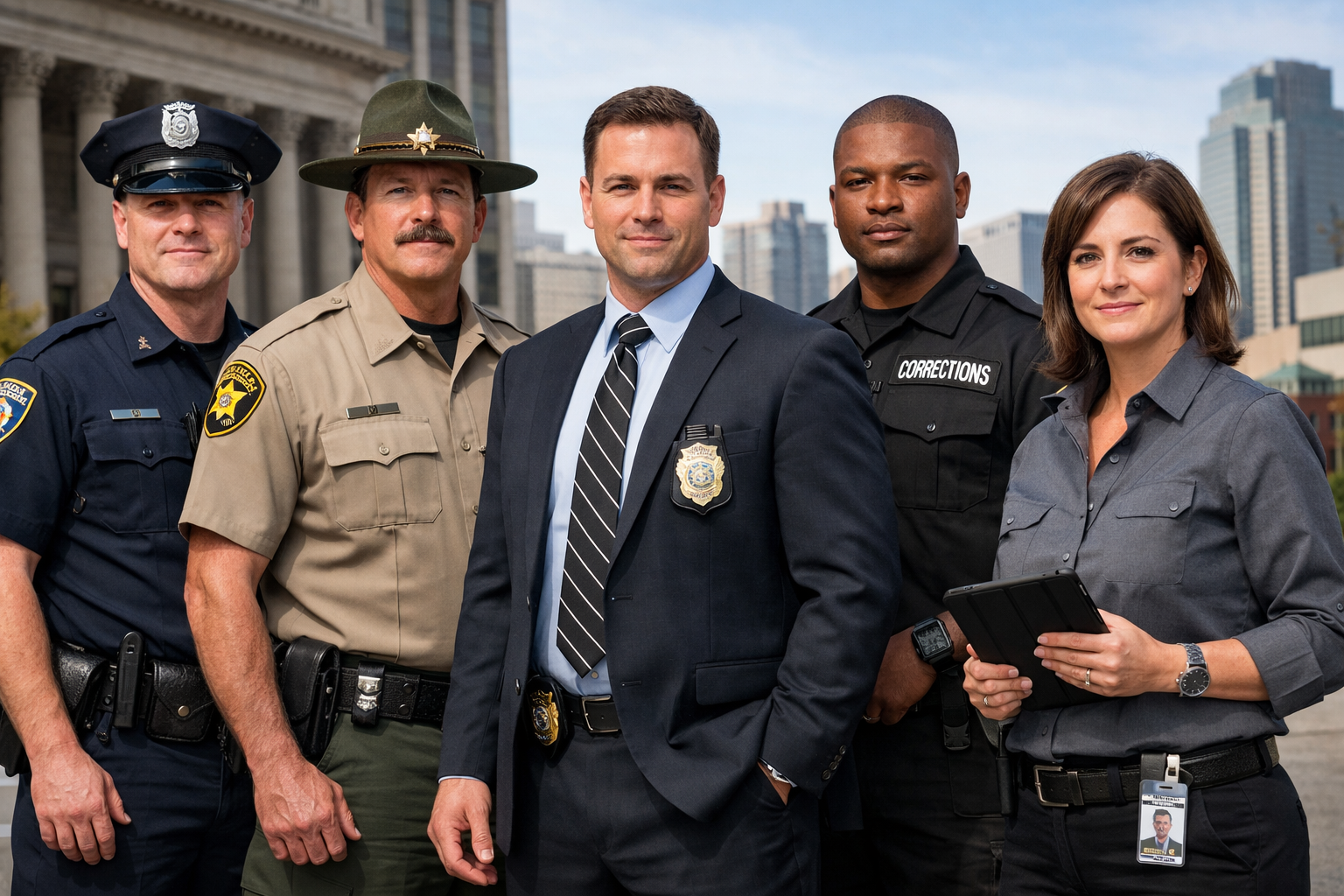
The answer depends entirely on where you draw the line — and where you draw it matters more than most people realize.
Ask the question narrowly and you get one number. Ask it broadly — including every category of person who carries a badge, supervises offenders, holds custodial authority, or works inside the criminal justice system in a law enforcement capacity — and you get a number that is significantly larger, and that tells a more complete story about the scale of this profession in American life.
Here is the full picture, category by category, built from the most current available data.
Sworn Law Enforcement: State and Local
This is the number most people mean when they ask how many police officers are in the United States — the sworn officers working in local police departments, county sheriff's offices, and state police and highway patrol agencies.
National police officer employment reached approximately 667,000 in 2024, a marginal increase from pre-2019 levels — representing roughly 0.3 percent growth over five years. SafeHome That near-flat trajectory masks significant variation at the state level. Oklahoma saw the largest increase at 33 percent, while Maryland experienced the steepest decline at 27 percent. SafeHome
Local police departments employ the largest share of officers at approximately 67 percent of the total sworn workforce, though they experienced modest declines in recent years driven by accelerated retirements and recruitment challenges. The Global Statistics
The geographic concentration is significant. California leads with approximately 148,000 police officers, followed by Texas at approximately 140,000 and New York at approximately 126,000. World Population Review
As of 2023, policing in the United States is conducted by around 18,000 federal, state, and local law enforcement agencies, all with their own rules, structures, and funding. Wikipedia
Running total: approximately 667,000 sworn state and local officers
Federal Law Enforcement
Federal law enforcement is substantially larger than most civilians — and many officers — carry in their heads.
Federal law enforcement personnel number approximately 137,000 full-time officers authorized to make arrests and carry firearms, serving across more than 90 federal agencies. - The Department of Homeland Security alone employs approximately 80,000 officers across nine agencies and offices, making it the largest federal law enforcement employer in the nation. Office of Homeland Security Statistics
The federal picture in 2026 is also in significant flux. The passage of major border security legislation in July 2025 triggered aggressive recruitment campaigns, with Immigration and Customs Enforcement more than doubling its workforce from 10,000 to over 22,000 officers and agents in just four months. - Meanwhile, U.S. Customs and Border Protection achieved an 84 percent increase in Border Patrol agent hiring compared to the same period the previous year. -
At the same time, other federal agencies are contracting. The Trump administration's FY 2026 budget proposes significant reductions to the FBI, DEA, and ATF — with ATF facing a proposed 29 percent funding cut that would shrink the bureau from over 5,000 budgeted positions to approximately 3,671 employees. -
Running total: approximately 804,000 sworn officers at state, local, and federal levels
Correctional Officers and Jailers
Corrections is one of the most understated categories in any count of law enforcement professionals — and one of the most significant in terms of raw numbers.
Correctional officers and jailers held approximately 387,500 jobs in 2024, with bailiffs holding an additional 19,000 positions. U.S. Bureau of Labor Statistics This workforce supervises the incarcerated population across federal prisons, state penitentiaries, county jails, and private correctional facilities.
The corrections sector is facing significant structural pressure. Overall employment of correctional officers is projected to decline 7 percent from 2024 to 2034 U.S. Bureau of Labor Statistics, driven by both declining incarceration rates in some jurisdictions and persistent staffing crises in others. The drop in correctional workers has been more marked than in any other state government sector in recent years, with some facilities operating at half their required officer complement. The Marshall Project
Running total: approximately 1.2 million
Probation and Parole Officers
Often overlooked in law enforcement counts entirely, probation and parole officers represent a substantial workforce with genuine law enforcement authority — including, in many jurisdictions, the authority to carry firearms, conduct searches, and make arrests.
Probation officers and correctional treatment specialists held approximately 92,300 jobs in 2024. U.S. Bureau of Labor Statistics Employment in this sector is projected to grow 3 percent from 2024 to 2034 U.S. Bureau of Labor Statistics, driven by continued demand for community supervision as an alternative to incarceration.
Running total: approximately 1.29 million
The Broader Law Enforcement Adjacent Universe
Beyond the four primary categories above, the United States employs a substantial population of law enforcement adjacent professionals whose work is directly within the criminal justice system but who are often excluded from standard counts. This includes campus police officers, tribal law enforcement officers, court security officers, bailiffs, park rangers with law enforcement authority, wildlife and game wardens, transportation security officers, military police, and civilian employees of law enforcement agencies in roles with significant operational responsibility.
These categories collectively add several hundred thousand additional professionals to the picture. The precise total is difficult to establish because definitions vary, reporting is inconsistent across jurisdictions, and some categories — particularly campus police and tribal law enforcement — are systematically undercounted in national surveys.
A conservative estimate for this broader category is approximately 300,000 to 400,000 additional professionals.
The Full Picture
Assembling the categories with the best available data produces the following approximate totals for 2026:
Sworn state and local law enforcement officers: ~667,000 Federal law enforcement officers: ~137,000 Correctional officers and jailers: ~387,500 Probation and parole officers: ~92,300 Law enforcement adjacent professionals:~300,000–400,000
Total: approximately 1.5 to 1.6 million people working in law enforcement or law enforcement adjacent roles in the United States.
That is roughly one in every 200 Americans. One in every 100 working adults. A profession that, by any measure, represents one of the largest organized workforces in the country — larger than the active duty military, larger than the entire federal civilian workforce, larger than the teaching workforce of most individual states.
Why the Number Matters
Understanding the scale of this profession matters for several reasons that go beyond statistics.
It matters for resource allocation — training budgets, wellness programs, mental health infrastructure, and policy development all look different when the profession's actual size is understood rather than approximated from the most commonly cited sworn officer figure.
It matters for research — studies on officer wellness, occupational stress, and professional culture that focus only on sworn patrol officers are studying a subset of a much larger population that shares many of the same occupational exposures and stressors.
And it matters for anyone trying to understand the reach of law enforcement professional culture in American communities. With 46 percent of all law enforcement departments employing fewer than 25 officers The Global Statistics, this is not a profession concentrated in large urban agencies. It is distributed across every county, every small town, every rural jurisdiction in the country — embedded in communities in ways that the aggregate national number does not fully convey.
One and a half million people. Their families. Their communities. Their calls.
That is who this publication is written for.
ThreatReady LE publishes weekly intelligence on threat recognition and trauma-informed practice for law enforcement. Subscribe free at threatreadyle.com.
Frequently Asked Questions
Why do different sources give such different numbers for how many police officers there are?
Because they are measuring different things, using different definitions, and drawing from different data sources — and none of them are fully transparent about which of those choices they have made. The FBI's Uniform Crime Reporting program counts sworn officers who are reported voluntarily by participating agencies — which means non-reporting agencies are excluded and the count is systematically lower than the true total. The Bureau of Labor Statistics counts people employed in law enforcement occupations using employer survey data — a different methodology that produces different numbers. The Bureau of Justice Statistics conducts periodic censuses of law enforcement agencies that capture a broader picture but are not conducted annually. When you see different figures cited in different articles, the disagreement is almost always definitional and methodological rather than factual. None of the sources is wrong. They are answering slightly different versions of the same question.
Why are correctional officers usually left out of counts of law enforcement professionals?
Partly definitional, partly cultural. The term law enforcement has come to be associated primarily with patrol and investigative functions — the officers who respond to calls, make arrests on the street, and interact with the public in visible ways. Correctional officers work inside facilities, supervise an already-adjudicated population, and are institutionally separated from the agencies that conduct street-level law enforcement. The BLS categorizes them separately, the FBI does not include them in its law enforcement employment counts, and the public discourse about policing rarely includes them. This exclusion has real consequences — correctional officers face occupational stress, secondary traumatic stress, and wellness challenges that are in many respects more severe than those faced by patrol officers, and the research and resource investment in their wellbeing significantly lags the patrol officer population.
Are federal law enforcement numbers actually growing or shrinking in 2026?
Both simultaneously, depending on which agency you are looking at. Border and immigration enforcement agencies have seen unprecedented growth driven by major legislation passed in July 2025, with ICE more than doubling its workforce in just four months. - At the same time, the proposed FY 2026 budget calls for significant reductions to the FBI, DEA, and ATF - — agencies whose missions are oriented toward domestic criminal investigation rather than border enforcement. The federal law enforcement workforce in 2026 is being actively reshaped in ways that will take several years to fully measure, and any single headline figure about federal officer numbers is capturing a snapshot of a rapidly moving picture.
How does the U.S. compare to other countries in terms of officers per capita?
The U.S. sits in the middle of the international range — significantly higher than some peer nations and lower than others. The overall national rate is approximately two sworn officers per 1,000 residents, though this varies enormously by jurisdiction. The District of Columbia has 70 officers per 10,000 residents — the highest rate in the nation SafeHome— reflecting its unique status as the national capital with concentrated federal and local law enforcement presence. Rural jurisdictions often operate at rates far below the national average. Cross-national comparisons are further complicated by definitional differences — countries vary significantly in which functions they include in law enforcement counts and how they categorize paramilitary, border, and correctional personnel.
Is the corrections staffing crisis as serious as it seems?
The available data suggests it is genuinely severe in many jurisdictions. Corrections has seen a more marked staffing decline than any other state government sector in recent years, with some facilities operating at half their required officer complement. The Marshall Project The consequences documented in investigative reporting include mandatory overtime at levels that produce burnout and safety failures, inability to provide basic services to incarcerated populations, and in some cases conditions that have drawn federal scrutiny. The BLS projects a continued 7 percent decline in correctional officer employment through 2034, driven by both declining incarceration in some jurisdictions and the difficulty of recruiting and retaining workers in one of the most physically and psychologically demanding jobs in the public sector.
Why is probation and parole such a small number compared to the other categories?
Because probation and parole officers supervise a very large population with a relatively small workforce — the ratio of officers to caseload is often the defining feature of the job rather than the raw employment number. Approximately 92,300 probation and parole officers manage a supervision population that exceeded 3.6 million adults U.S. Bureau of Labor Statistics — a ratio that creates chronic caseload pressure and limits the depth of supervision any individual officer can provide. The small workforce relative to the population it supervises is not evidence that the function is minor. It is evidence that it is significantly under-resourced relative to its scope.
Do private security officers count as law enforcement adjacent?
They occupy complicated and variable territory. Private security officers in most jurisdictions do not have law enforcement authority — they cannot make arrests beyond citizen's arrest powers, carry firearms only under specific licensing conditions, and operate under private rather than governmental authority. However, the line blurs significantly in certain contexts: armed security contractors who provide services to government facilities, former officers working security in roles that involve active law enforcement coordination, and campus security officers who in many jurisdictions have full sworn officer status. For the purposes of this article's count, private security is not included — but the full universe of people doing security and quasi-law enforcement work in the United States is substantially larger than the 1.5 million figure presented, with the private security workforce alone estimated at over 1 million workers.
How many of the 1.5 million are women?
The numbers vary significantly by category. Women make up approximately 14 to 17 percent of full-time sworn law enforcement officers The Global Statistics — a figure that has grown gradually over decades but remains low relative to the general workforce. Corrections presents a different picture — correctional officers skew more male U.S. Bureau of Labor Statistics but the gender distribution is less extreme than in patrol. Probation and parole is notably different from both: the probation and parole officer workforce is majority female U.S. Bureau of Labor Statistics, making it the significant exception to the male-dominated pattern across the broader law enforcement professional category. The aggregate picture across all 1.5 million professionals is a workforce that is majority male but with significant variation by sector and function.
Does this publication cover all of these categories or primarily patrol officers?
ThreatReady LE is written for the full spectrum of law enforcement and law enforcement adjacent professionals — not exclusively patrol. The threat recognition content, the behavioral science, the officer wellness material, and the domestic violence resources on this site are relevant to corrections officers managing volatile populations, probation officers conducting home visits, federal agents working extended investigations, and dispatchers absorbing crisis calls from behind a console. The patrol officer context is the most common framing because it is the most universally recognizable entry point into these topics — but the underlying science and the human cost of this work extend across every category counted in this article.